


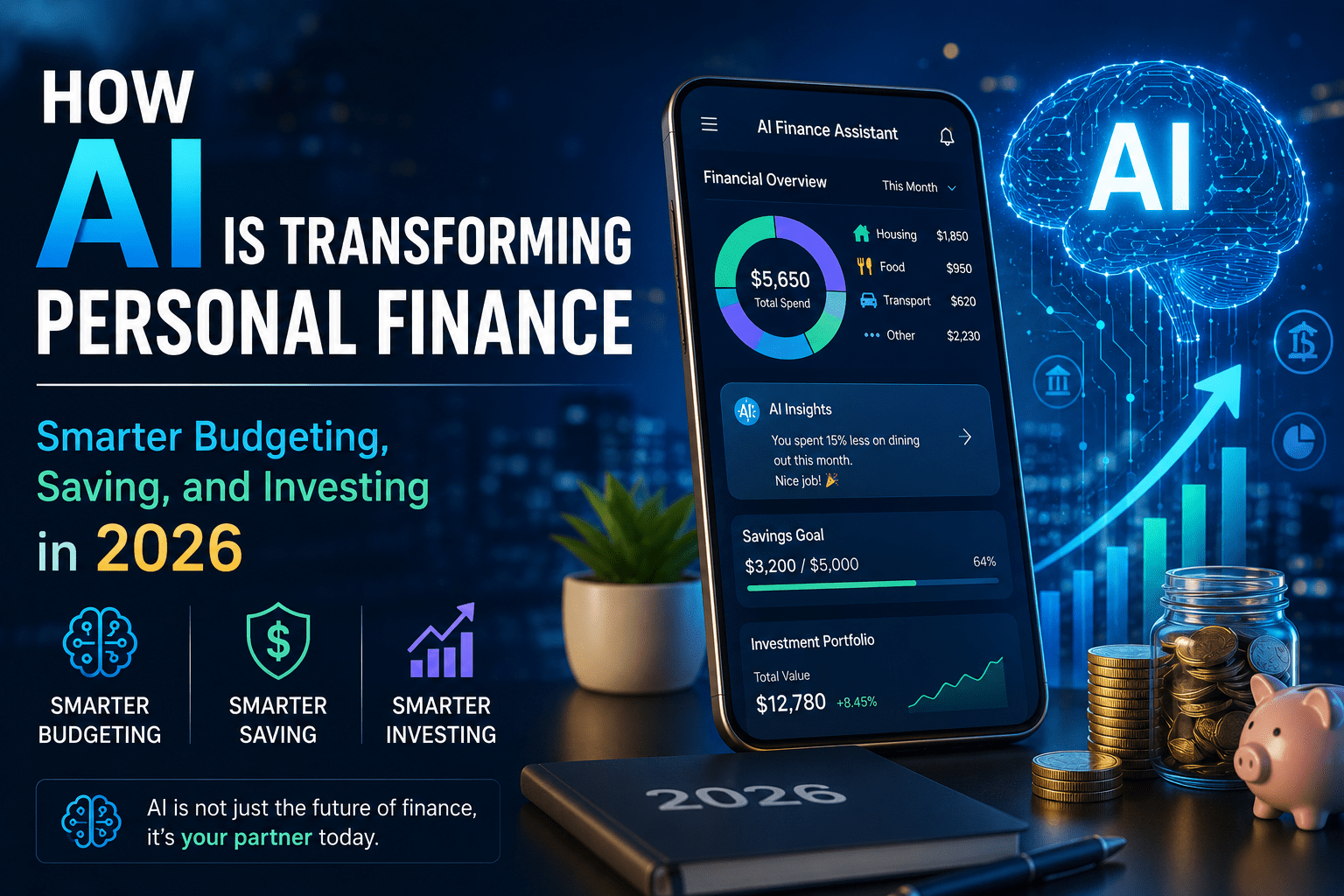
Introduction: The AI Money Revolution Is Here
If you opened your banking app five years ago, you saw a list of transactions. If you open it today, you might see an AI asking if that $47 charge at the coffee shop was intentional—or warning you that your account will dip below your comfort zone before payday. The transformation is not subtle. It is structural. And in 2026, it is accelerating faster than most people realize.
Artificial intelligence has moved from a marketing buzzword slapped onto financial apps to the invisible engine reshaping how billions of people budget, save, invest, and protect their money. According to EY’s 2026 Global AI Sentiment Survey, nearly half (49%) of global consumers have used AI to support savings and investment decisions in the past six months alone . That is not early adoption. That is mainstream.
But here is the truth most articles won’t tell you: not all AI in personal finance is created equal. Some tools genuinely make you wealthier. Others just make you feel like you are doing something productive while your money stays exactly where it was. This article cuts through the noise. We will explore how AI is actually transforming personal finance in 2026—what works, what doesn’t, and how you can use it to build real financial security.
Whether you are a Gen Z professional just starting your wealth journey, a millennial juggling mortgages and retirement goals, or someone who has never felt confident with money, this guide will show you exactly how to leverage AI without falling into the traps that cost people thousands.
The State of AI in Personal Finance: 2026 and Beyond
From Chatbots to Ecosystems
The first wave of AI in personal finance was embarrassingly simple. You asked a chatbot “What is my balance?” and it read a number back to you. That was 2022. Fast forward to 2026, and the landscape looks completely different.
Today’s AI financial tools do not just answer questions—they anticipate problems. They do not just categorize transactions—they predict cash flow weeks in advance. They do not just track spending—they intercept potentially harmful financial decisions before you make them .
The shift from reactive to proactive is the defining characteristic of AI personal finance in 2026. Where older tools told you where your money went, modern AI tells you where it is going—and gives you the power to change that trajectory while you still can.
The Numbers Don’t Lie
The adoption statistics paint a clear picture of where we are headed:
- 49% of global consumers have used AI for savings and investment decisions in the past six months
- 50% believe AI can help detect and prevent financial fraud
- 21% use AI agents for financial product recommendations
- 18% use AI specifically for budgeting and household finance management
- Adoption is highest among Gen Z, university graduates, and full-time employees
These numbers matter because they represent a fundamental shift in trust. People are no longer experimenting with AI finance tools—they are depending on them. And that dependency creates both opportunity and responsibility.
How AI Is Revolutionizing Budgeting in 2026
Multi-Modal Input: Talk to Your Money
The most immediate change you will notice in 2026 budgeting apps is how you interact with them. The era of manually tapping through forms to log expenses is dying. In its place, a new paradigm is emerging: multi-modal input.
Modern AI budgeting tools let you log expenses by:
- Typing naturally: “Lunch at Chipotle, $14.50”
- Speaking: Dictate expenses while walking to your car
- Snapping photos: Point your camera at a receipt and watch the AI extract every detail
- Uploading statements: Drop a screenshot of your bank statement and let the AI parse it
This matters more than it sounds. Research consistently shows that the biggest barrier to consistent budgeting is friction. The more steps required to log an expense, the less likely people are to do it. By reducing expense logging to a single sentence or photo snap, AI removes the primary excuse people have for not tracking their money.
Apps like Finny have built their entire experience around this principle—no bank link required, just text, voice, or receipt scan, with AI suggesting categories and you confirming . The result? People who never stuck with budgeting before are suddenly building consistent habits.
Smarter Auto-Categorization That Actually Learns
Auto-categorization is not new. What is new in 2026 is that it actually works.
Older systems used rigid merchant-to-category mappings. Every Amazon purchase went to “Shopping.” Every Starbucks charge went to “Food & Dining.” But anyone who has bought groceries on Amazon or received a Starbucks gift card knows that one-size-fits-all categorization creates more confusion than clarity.
The 2026 approach is different. Apps like Copilot Money and Monarch Money now build per-user models that learn from your corrections . Categorize one Amazon purchase as “Groceries” and the AI notices. Correct a Venmo transfer to “Rent” instead of “Entertainment” and the system adapts. Over time, the model understands your personal spending logic—not just merchant names.
The practical impact is enormous. When your budgeting app correctly categorizes 90%+ of transactions without intervention, you spend less time managing money and more time making decisions about it. That is the difference between budgeting as a chore and budgeting as a tool.
Predictive Cash Flow: See the Future Before It Happens
If multi-modal input and smart categorization look backward, predictive cash flow looks forward—and this is where 2026 AI truly shines.
Modern AI budgeting tools model your recurring income and bills, then project where your balance is headed days or weeks in advance . The alerts are no longer reactive (“You spent $50 on dining this week”). They are proactive:
- “Your rent, car payment, and credit card bill all clear next Tuesday. Based on your current balance, you may run $120 short.”
- “We noticed a new $14.99 subscription charge. Did you mean to sign up for this?”
- “Your spending pattern suggests you will exceed your grocery budget by Thursday. Want to adjust now?”
This shift from after-the-fact summaries to real-time intervention is the single most powerful budgeting innovation of 2026. It transforms budgeting from a historical record into a navigation system. You are no longer looking at where you have been—you are steering where you are going.
Conversational Coaching: Your Money, in Plain English
Perhaps the most accessible AI budgeting feature of 2026 is conversational coaching. Instead of navigating complex dashboards and reports, you simply ask questions in plain English:
- “How much did I spend on dining out last quarter?”
- “Can I afford a $400 flight this month?”
- “What percentage of my income went to subscriptions?”
Apps like Monarch Money’s AI Assistant and ChatGPT’s Plaid integration have made this mainstream . The barrier to understanding your finances has dropped from “learn to read financial reports” to “ask a question like you would ask a friend.”
For people who have historically avoided budgeting because it felt intimidating, this is revolutionary. A conversational interface does not just make budgeting easier—it makes it possible for people who would never have opened a spreadsheet in their lives.
AI-Powered Saving: From Willpower to Automation
The Death of Manual Saving
Let’s be honest: traditional saving advice is exhausting. “Pay yourself first.” “Set up automatic transfers.” “Track every dollar.” These principles work, but they require discipline most people do not have consistently. Life gets busy. Willpower fails. And suddenly that emergency fund you were building has not grown in three months.
AI is changing this by making saving automatic, intelligent, and invisible.
Behavioral AI: The Psychology of Saving
The most fascinating AI saving tools of 2026 do not just move money—they understand why you spend it. Apps like Cleo have built entire platforms around behavioral psychology . Cleo’s famous “Roast Mode” reviews your purchases and delivers blunt feedback: “You spent $87 on takeout this week. Your future self is crying.”
It sounds silly, but it works. For people who have never stuck with a savings plan, shame and humor are more effective than spreadsheets. Cleo also offers “Hype Mode” for those who respond better to encouragement than criticism .
The underlying principle is behavioral economics: AI can identify your spending triggers, predict when you are vulnerable to impulse purchases, and intervene at exactly the right moment. Not with generic advice, but with personalized nudges based on your actual patterns.
Proactive Savings Interception
The cutting edge of AI saving in 2026 goes beyond behavioral prompts to proactive interception. Tools like Whistl do not wait for you to decide to save—they create the decision for you .
Here is how it works: the AI monitors your accounts in real-time. When it detects that you have discretionary money sitting in checking that you are likely to spend impulsively, it suggests (or automatically executes) a transfer to savings before the temptation strikes. This “pre-spend save” mechanism reframes saving from restriction to empowerment .
Instead of feeling like you are denying yourself something, you feel like you are securing your future before your present self can mess it up. It is subtle. It is psychological. And it is remarkably effective.
Goal-Based AI Saving
Modern AI saving tools also excel at goal visualization. Tell the AI you want to save $5,000 for a vacation in eight months, and it does not just divide $5,000 by eight. It considers:
- Your income patterns and irregularities
- Your historical saving behavior
- Upcoming expenses that might interfere
- The optimal account for the goal (high-yield savings vs. investment account)
Then it creates a dynamic plan that adjusts as your life changes. Get a bonus? The AI suggests putting half toward the goal. Hit an unexpected expense? It recalculates without making you feel like you failed.
This adaptive approach is why AI-powered savers report higher success rates than traditional methods. The plan bends so it does not break.
AI in Investing: The Democratization of Wealth Building
Beyond Robo-Advisors: The 2026 Evolution
Robo-advisors like Betterment and Wealthfront have been around for years. They use algorithms to create diversified portfolios based on your risk tolerance and time horizon. They are fine. They are also boring—and in 2026, boring is not enough.
The new generation of AI investing tools does three things traditional robo-advisors cannot:
- Explain their decisions in plain English (not just “you have 60% stocks”)
- Adapt to market conditions in real-time (not just rebalance quarterly)
- Integrate investing with your complete financial picture (not treat it as a siloed account)
Advisor-Grade AI vs. Generic AI
Here is a critical distinction most articles miss: there is a massive difference between asking ChatGPT “Should I invest in Tesla?” and using an advisor-grade AI system like Origin .
Generic AI tools can explain what an ETF is. They can summarize market trends. What they cannot do is analyze your complete financial situation—your tax bracket, your debt obligations, your employer’s 401(k) match, your risk tolerance, your time horizon—and synthesize all of that into a coherent investment strategy .
Advisor-grade AI systems can. They connect to your actual accounts, understand your real cash flow, and provide recommendations grounded in your verified data—not generic principles .
The difference is the difference between reading a fitness magazine and having a personal trainer who knows your body. Both can give you advice. Only one can give you your advice.
Real-Time Portfolio Intelligence
In 2026, AI investment tools do not just build your portfolio—they watch it constantly. BlackRock’s Aladdin Wealth platform, for example, uses generative AI to produce narrative commentary on client portfolios, merging risk analytics, market outlook, and portfolio data into coherent insights .
Instead of receiving a quarterly report with charts you do not understand, you get a plain-English summary: “Your portfolio is currently overweight in technology stocks compared to your target allocation. Given recent market volatility and your stated preference for conservative growth, consider rebalancing 5% into bonds.”
This is not just convenient. It is empowering. When you understand why your portfolio is positioned a certain way, you are less likely to panic-sell during market downturns. And not panic-selling is, historically, one of the most reliable ways to build wealth.
Tax-Loss Harvesting and Optimization
AI has also made sophisticated tax strategies accessible to everyday investors. Tax-loss harvesting—selling losing investments to offset capital gains taxes—used to require a human advisor and significant assets. Now, AI algorithms can execute this strategy automatically across your portfolio, saving you money without you lifting a finger.
The best 2026 platforms combine tax optimization with goal-based planning. They do not just minimize your tax bill this year; they model the tax implications of different strategies over decades and recommend the approach that maximizes your after-tax wealth.
Privacy, Security, and the AI Finance Dilemma
The Data Trade-Off
Here is the uncomfortable truth about AI personal finance: the more powerful the AI, the more data it needs. And the more data you give it, the more you have to trust it.
Most AI finance tools work by connecting to your bank accounts through aggregators like Plaid. They ingest your transaction history, spending patterns, income data, and sometimes even your investment holdings. This is how they provide personalized insights. It is also how they create a massive target for data breaches .
The Privacy-First Countermovement
In response to these concerns, a privacy-first movement is gaining real momentum in 2026. Apple has led the charge with Apple Intelligence, which processes most AI tasks on-device and routes complex requests through Private Cloud Compute, where personal data is not stored or accessible to anyone .
Apps like Finny take this even further by not requiring a bank link at all. You log expenses manually (via text, voice, or receipt scan), and the AI processes your inputs without ever touching your bank credentials .
The trade-off is clear: privacy-first tools sacrifice some convenience for security. You will not get automatic transaction import, but you also will not worry about a data breach exposing your entire financial life.
What You Should Do
Our recommendation is tiered:
- For daily spending tracking: Use a privacy-first tool that does not require bank linking
- For investment management: Use an established platform with robust security (Schwab, Fidelity, Vanguard) that has added AI features
- For comprehensive financial planning: If you use an AI advisor, ensure they have SOC 2 compliance, encryption at rest and in transit, and clear data deletion policies
Never give an AI tool access to accounts you cannot afford to have compromised. And always enable two-factor authentication. These are not paranoia—they are basic hygiene in 2026.
The Best AI Personal Finance Tools of 2026: A Practical Guide
For Serious Budgeters: YNAB
You Need A Budget (YNAB) remains the gold standard for people who want to fundamentally change their relationship with money. At $109/year, it is not cheap, but its zero-based budgeting method—where every dollar gets a job before you spend it—has a proven track record of getting people out of paycheck-to-paycheck cycles .
The 2026 version adds AI-assisted future-month planning and debt payoff calculators tied to goals. It is not the most automated tool, but it is the most effective for behavior change.
For Apple Ecosystem Users: Copilot Money
If you live in the Apple universe, Copilot Money ($95/year) is hard to beat. It runs locally on your devices, processes AI summaries on-device for privacy, and offers the smartest auto-categorization in the industry . The catch: no Android app. If your household is split between iPhone and Android, look elsewhere.
For Couples and Families: Monarch Money
Monarch Money ($99.99/year) is the best choice for shared finances. It works across iOS, Android, and web, lets both partners see real-time data, and assigns transactions to individuals . The AI assistant answers natural-language questions, though its advice is more “smart summaries” than true financial planning.
For Subscription Cleanup: Rocket Money
If you suspect you are leaking money to forgotten subscriptions, Rocket Money is your tool. Its algorithm scans linked accounts, surfaces every recurring charge, and cancels them for you—no phone calls required . The free tier covers detection; premium ($6-$12/month) adds cancellation and bill negotiation.
For Comprehensive Wealth Planning: Origin
Origin stands out for refusing to treat budgeting as separate from investing, taxes, and retirement planning. Its AI advisor answers questions grounded in your actual data, so you can ask whether this month’s spending is hurting your retirement and get a real answer . Currently $1 for the first year, then standard pricing.
For Beginners: Cleo
If you have never stuck with a finance app, start with Cleo. Its chat-first interface, free core features, and behavioral psychology approach make it the most engaging entry point . Be cautious about cash advances (express fees of $3.99-$9.99 apply), but the budgeting and saving tools are genuinely effective.
The Limitations: What AI Cannot Do (Yet)
The Hallucination Problem
Large language models are built to produce plausible text, not verified truth. In personal finance, this is dangerous. An AI can state a wrong number with total confidence: a misread receipt total, a forecast that assumes income you do not have, or investment advice that ignores your tax situation .
The rule for 2026: Never act on AI financial advice without verification. If an AI suggests moving $10,000, check the math yourself. If it recommends an investment, confirm with a second source. AI is an accelerator, not a replacement for human judgment.
Context Blindness
No AI tool automatically knows your full financial picture unless you give it everything. It does not know your tax bracket, your employer’s 401(k) match, your debt interest rates, or your risk tolerance unless you explicitly provide them .
This means AI advice is only as good as the data you feed it. Garbage in, garbage out. The most expensive mistake you can make is assuming an AI understands your situation when it only knows what you have told it.
Regulatory and Fiduciary Gaps
Most AI finance tools are not fiduciaries. They are not legally required to act in your best interest. They may recommend products that earn them commissions. They may prioritize engagement over your financial health .
Until regulatory frameworks catch up with AI capabilities, the responsibility for verifying advice remains squarely on you.
The Future: Where AI Personal Finance Is Headed
AI Agents, Not Just Assistants
The next evolution beyond 2026 is AI agents that can take action on your behalf—not just suggest, but execute. Imagine an AI that:
- Automatically negotiates your bills when it detects you are overpaying
- Rebalances your portfolio in response to market shifts without you logging in
- Files your taxes by pulling data from all your accounts and submitting the return
These capabilities exist in fragments today. By 2027-2028, they will likely be integrated into comprehensive financial agents that manage your money with minimal intervention.
Hyper-Personalization at Scale
As AI models improve, the gap between robo-advice and human advice will narrow. The future is not AI replacing financial advisors—it is AI making advisor-level guidance accessible to people who cannot afford $300/hour human advisors.
Embedded Finance Everywhere
AI financial tools will not live only in apps. They will be embedded in your car (suggesting you save your gas money rebate), your smart home (adjusting your thermostat to hit your savings goal), and your workplace benefits portal (optimizing your 401(k) contributions in real-time).
Conclusion
AI has transformed personal finance from a discipline requiring spreadsheets, discipline, and often professional help into something accessible, intelligent, and increasingly automatic. In 2026, you can:
- Budget using multi-modal input and predictive cash flow that warns you before problems happen
- Save through behavioral AI that understands your psychology and intercepts impulse spending
- Invest with advisor-grade AI that explains decisions in plain English and optimizes for taxes
But the technology is not magic. It requires:
- Verification: Always check AI-generated numbers and advice
- Privacy awareness: Choose tools that match your comfort level with data sharing
- Human oversight: Keep yourself in the loop for major decisions
The healthiest mental model for AI in personal finance is simple: let AI handle the fast, repetitive work, and keep a human in the loop for the judgment calls .
If you are just starting out, pick one tool from our recommendations above and commit to using it for 30 days. If you are already using AI finance tools, audit whether they are actually making you wealthier—or just making you feel productive.
The AI money revolution is not coming. It is here. The only question is whether you will use it to build the financial future you deserve.
References and External Links:
- EY Global AI Sentiment Survey 2026 – “Nearly half of global consumers now use AI to guide savings and investment decisions”
- Finny Blog – “AI in Personal Finance: 7 Trends Shaping 2026”
- Dupple – “Best AI Personal Finance Tools (2026)”
- Whistl – “AI-Driven Financial Planning in 2026: Tools, Trends and What Works”
- Origin – “AI vs Human Financial Advisors: Comprehensive 2026 Comparison”
- Jump AI – “The 10 Best AI Tools For Financial Advisors in 2026”
- Remio AI – “Top 10 AI Personal Finance Apps in 2026”
- Agentic AI – “11 Best AI Finance & Planning Tools in 2026”
- Bleap Finance – “The Best AI Tools for Personal Finance in 2026”
- Advisor360° – “Generative AI Use Surges Among Financial Advisors”


Leave a Reply