


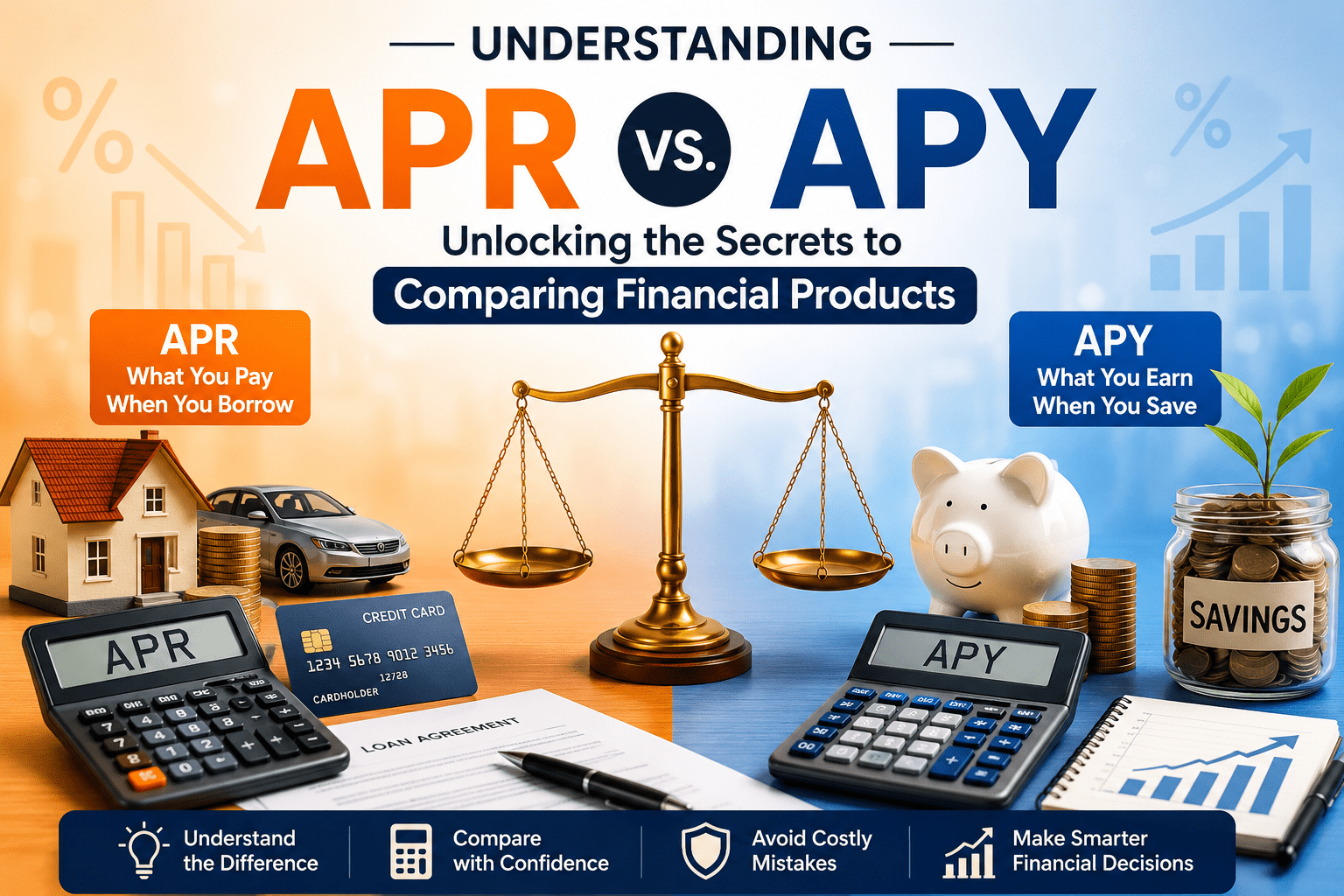
Two small acronyms. Three letters each. And yet, the gap between APR and APY quietly costs — or earns — people thousands of dollars every single year.
Here’s a situation that plays out every day. Someone compares two credit card offers and picks the one with the lower number, assuming “lower is better.” Across town, another person opens a savings account because the bank’s billboard showed a bigger percentage, assuming “bigger is better.” Both people made a decision based on a number they didn’t fully understand — because one was looking at APR, the other at APY, and neither realized these two figures measure money in fundamentally different ways.
If you’ve ever felt that financial products are deliberately confusing, you’re not entirely wrong. Lenders and banks each choose the metric that makes their offer look most attractive. Your defense is simple: understand what each number actually means, know when each one applies, and learn to convert between them so you can compare any two offers on equal footing.
That’s exactly what this guide will teach you. By the end, you’ll know the precise difference between APR and APY, the math that connects them, how each one behaves across credit cards, mortgages, loans, savings accounts, and CDs — and a practical framework for comparing any financial product with total confidence.
Disclaimer: This article is for educational purposes only and does not constitute financial advice. Always review the official terms of any financial product before committing.
Key Takeaways
- APR = the cost of borrowing. APY = the return on saving. One is your bill; the other is your paycheck.
- The only real difference between them is compounding — APR excludes it, APY includes it.
- Lenders advertise APR because it looks smaller; banks advertise APY because it looks bigger. Convert between them before comparing anything.
- Always compare APR to APR on loans and APY to APY on deposits — and then audit fees, terms, and penalty clauses.
- In mid-2026, top savings accounts pay up to 4.50% APY while average credit card APRs sit above 20% — making high-APY saving and high-APR debt payoff the two highest-value moves available to most households.
- When in doubt, run the numbers in dollars, not percentages. A free calculator and thirty seconds will tell you more than an hour of reading advertisements.
What Is APR?
APR stands for Annual Percentage Rate. It represents the yearly cost of borrowing money, expressed as a percentage of the amount you borrowed.
Think of APR as the “price tag” on a loan. When you borrow money — whether through a credit card, mortgage, auto loan, or personal loan — the lender charges you for the privilege. APR bundles that cost into a single annualized figure.
Crucially, APR typically includes more than just the interest rate. Depending on the loan type, it can fold in:
- Origination fees charged for processing the loan
- Mortgage points (prepaid interest)
- Closing costs and certain broker fees
- Mortgage insurance premiums (where applicable)
This is why a mortgage advertised at “6.5% interest” might carry an APR of 6.72% — the APR is capturing fees that the headline interest rate hides. In the United States, lenders are legally required to disclose APR under the Truth in Lending Act (TILA), enforced by the Consumer Financial Protection Bureau (CFPB). The law exists for one reason: so you can compare loan offers apples-to-apples instead of being misled by a low headline rate paired with heavy fees.
The different flavors of APR you’ll encounter:
- Purchase APR — the rate applied to things you buy with a credit card
- Balance transfer APR — the rate on debt moved from another card (often 0% for an introductory period)
- Cash advance APR — usually higher, and it starts accruing immediately with no grace period
- Penalty APR — a punitive rate (sometimes near 29.99%) triggered by late payments
- Introductory APR — a temporary promotional rate that expires, often after 6–21 months
- Fixed vs. variable APR — fixed stays the same; variable moves with a benchmark like the prime rate
One important nuance: APR does not account for compounding. It assumes simple interest over the year. That single fact is the entire reason APY exists — and it’s where most confusion begins.
What Is APY?
APY stands for Annual Percentage Yield. It represents the real, effective rate of return you earn on a deposit account over one year — including the effect of compound interest.
APY is most commonly used for products that pay you: savings accounts, certificates of deposit (CDs), money market accounts, and some checking accounts. It’s the number banks splash across their websites in large font, and for good reason — it’s standardized, so an APY at one bank is directly comparable to an APY at another.
The magic ingredient in APY is compounding: the process where the interest you earn starts earning interest of its own. A bank might compound daily, monthly, quarterly, or annually. The more frequently interest compounds, the faster your money grows — and APY captures all of that in one clean number.
Here’s a simple illustration. Imagine an account with a 4.00% nominal interest rate:
- Compounded annually → APY is 4.00%
- Compounded quarterly → APY becomes roughly 4.06%
- Compounded monthly → APY becomes roughly 4.07%
- Compounded daily → APY becomes roughly 4.08%
Same advertised rate, four different actual returns. APY cuts through that ambiguity, which is exactly why U.S. banks must disclose it under the Truth in Savings Act (Regulation DD).
The golden rule to remember:
APR is what you pay when you borrow. APY is what you earn when you save.
APR vs. APY: The Core Difference at a Glance
Strip everything back, and the distinction comes down to one word: compounding. APR ignores it. APY embraces it.
Table
| Feature | APR (Annual Percentage Rate) | APY (Annual Percentage Yield) |
|---|---|---|
| What it measures | Cost of borrowing | Return on savings/investment |
| Includes compounding? | ❌ No | ✅ Yes |
| Includes fees? | ✅ Often (origination, points, closing costs) | ❌ Rarely |
| Where you see it | Credit cards, mortgages, auto loans, personal loans | Savings accounts, CDs, money market accounts |
| Who quotes it | Lenders | Banks and credit unions |
| Governed by (U.S.) | Truth in Lending Act (Reg Z) | Truth in Savings Act (Reg DD) |
| Better when it’s… | Lower | Higher |
| Your role | You’re the payer | You’re the earner |
There’s an elegant symmetry here. The same compounding effect that makes a savings account grow slightly faster than its nominal rate is also what makes credit card debt grow slightly faster than its stated APR. Compounding is neutral — it simply works for whoever is on the receiving end of the interest. Your goal in personal finance is to be that person as often as possible.
The Math Behind the Numbers
You don’t need to be a mathematician to master this — you need two formulas and thirty seconds.
Converting APR to APY (the effective rate)
APY=(1+nAPR)n−1
Where n = the number of compounding periods per year (12 for monthly, 365 for daily).
Worked example: A credit card charges 22.99% APR, compounded daily.
APY=(1+3650.2299)365−1≈25.85%
Read that again. The card advertises 22.99%, but if you carry a balance all year, the effective annual cost is closer to 25.85%. That nearly-three-point gap is the silent tax of daily compounding — and it’s why minimum payments barely dent a growing balance.
Converting a nominal savings rate to APY
Same formula, friendlier context. A savings account pays a 4.40% nominal rate, compounded daily:
APY=(1+3650.044)365−1≈4.50%
This is precisely why banks advertise 4.50% APY rather than the 4.40% nominal rate — compounding bumps the number up, and bigger numbers sell accounts.
What the difference means in real dollars
Take $10,000 and park it for one year at various rates, compounded monthly:
Table
| Rate | After 1 Year | Interest Earned |
|---|---|---|
| 0.38% (national average savings) | $10,038.00 | $38 |
| 3.00% | $10,304.16 | $304 |
| 4.50% (top high-yield savings) | $10,459.40 | $459 |
Now flip it. Carry a $10,000 credit card balance at 22.99% APR (compounded daily) and make no payments: you’d owe roughly $12,585 after one year — over $2,585 in interest. Same starting amount, opposite direction, entirely determined by which side of the APR/APY divide you’re standing on.
Want to run these numbers yourself without touching a formula? Use the free APY Calculator and Compound Interest Calculator on Deshmaj Tools — plug in any rate and compounding frequency and get instant results.
Why Lenders Advertise APR and Banks Advertise AP
Once you understand the math, the marketing becomes transparent — and a little amusing.
Lenders quote APR because compounding would make their product look more expensive. A credit card at “22.99% APR” sounds noticeably cheaper than “25.85% effective annual cost,” even though both describe the identical product. APR is the smallest honest number a lender can legally lead with.
Banks quote APY because compounding makes their product look more generous. A savings account with a 4.40% nominal rate becomes “4.50% APY” in the headline — the largest honest number available.
Neither practice is deceptive; both are fully legal and regulated. But they are strategic. Every financial institution, on both sides of the market, chooses the frame that flatters its product. The moment you can convert between APR and APY in your head (or with a calculator), the frames disappear and you see the raw product underneath. That skill alone puts you ahead of most consumers.
How APR and APY Work Across Different Financial Products
The theory matters less than the application. Here’s how these two metrics behave in the real world, product by product.
Credit Cards — APR territory
Credit cards live almost entirely in APR land: purchase APR, balance transfer APR, cash advance APR, and penalty APR. Two things to remember:
- Interest compounds daily, so the true cost exceeds the stated APR whenever you carry a balance.
- APR is irrelevant if you pay in full every month. The grace period means a 24.99% APR card costs you $0 in interest if the statement balance is cleared by the due date. The most powerful credit card strategy in existence is making the APR meaningless.
Mortgages — watch the APR/interest-rate gap
Mortgage ads show two numbers: the interest rate and the APR. The gap between them is your fee detector. A 6.40% rate with a 6.42% APR signals minimal fees; a 6.40% rate with a 6.85% APR signals heavy origination charges or discount points baked in. When comparing lenders, always compare APR to APR — never one lender’s APR against another’s interest rate. The CFPB’s guide on what APR means for mortgages is worth bookmarking.
Auto Loans and Personal Loans — APR, mostly flat
These are typically simple-interest installment loans, so APR and the interest rate are often nearly identical unless the lender charges an origination fee. The bigger lever here is the loan term: stretching a loan from 48 to 72 months lowers the monthly payment but dramatically increases total interest paid, even at the same APR.
Savings Accounts and Money Market Accounts — APY territory
Here you are the lender, and APY is your paycheck. Compare accounts on APY alone, then check the fine print: minimum balance requirements, monthly fees (which can erase a rate advantage entirely), withdrawal limits, and whether the rate is a short-lived promotional “teaser.”
Certificates of Deposit (CDs) — APY with a lock
CDs pay a fixed APY in exchange for locking your money for a set term — three months to five years. The APY is guaranteed, but early withdrawal usually triggers a penalty of several months’ interest. CDs reward certainty; savings accounts reward flexibility. Choose based on when you’ll genuinely need the cash.
Crypto Staking and DeFi — read the label twice
Crypto platforms blur the terminology deliberately. Some advertise “APR” (no compounding), others “APY” (with compounding), and the difference at high nominal rates is enormous — 100% APR compounded daily becomes roughly 171% APY. Add volatility, lock-ups, and platform risk, and the lesson is simple: never compare a crypto “APR” against a bank’s APY. Convert both to the same metric first.
The 2026 Rate Landscape: Why This Matters Right Now
Understanding APR and APY isn’t academic in 2026 — there’s real money on the table.
As of mid-July 2026, the top high-yield savings accounts are paying up to 4.50% APY, while the FDIC’s national average savings rate sits at just 0.38%, according to Fortune’s daily rate tracker. Independent reviewers at The Motley Fool confirm that the best accounts cluster between 4.00% and 4.50% APY.
Do the math on a $20,000 emergency fund: at the national average, that money earns about $76 a year. At 4.50% APY, it earns roughly $918. That’s an $842 annual difference for moving money you already have — no risk added, no lifestyle changed. This is possibly the highest-effort-to-reward ratio in all of personal finance.
Meanwhile, on the borrowing side, credit card APRs have remained historically elevated — the average rate on accounts assessed interest has hovered above 20% in recent years, per the Federal Reserve’s consumer credit data. That makes the spread between what banks pay savers (~4.50%) and what card issuers charge borrowers (20%+) wider than most people realize — and it makes paying down high-APR debt the closest thing to a guaranteed double-digit “return” available anywhere.
The 2026 takeaway: the gap between the best and worst financial products is unusually wide right now, which means the cost of not comparing them is unusually high.
How to Compare Financial Products Like a Pro
Here is the exact framework, whether you’re choosing a loan or a savings account:
Step 1 — Identify which side of the transaction you’re on. Borrowing? You’re shopping for the lowest cost. Saving? You’re shopping for the highest return. This determines which metric matters.
Step 2 — Standardize the metric before comparing anything. Never compare one product’s APR against another’s APY. If a lender gives you APR and a bank gives you APY, convert one of them using the formula above (or an online calculator) so both are on equal terms.
Step 3 — Compare APR to APR on loans — not interest rate to APR. The mortgage lender quoting a lower “rate” may be hiding fees that a competitor’s APR exposes. APR-to-APR comparison is the only honest method.
Step 4 — Compare APY to APY on deposits, then audit the conditions. Minimum balances, tiered rates, monthly fees, promotional expirations, and withdrawal limits can all turn a “4.50%” headline into a worse real-world deal than a flat 4.00%.
Step 5 — Check fixed vs. variable. A fixed rate is a promise; a variable rate is a starting point. On savings accounts, nearly all APYs are variable. On loans, a variable APR can climb with the prime rate.
Step 6 — Run the actual dollar figures. Percentages are abstractions; dollars are real. Before signing anything, calculate the total interest paid over the loan’s life, or the total interest earned over your savings horizon. Tools like the Loan Calculator and Compound Interest Calculator on Deshmaj Tools make this a thirty-second task.
Step 7 — Read the penalty clauses. Penalty APRs, early withdrawal penalties, and balance transfer fees live in the fine print, and they only appear when something goes wrong — which is exactly when you can least afford them.
7 Costly Mistakes People Make with APR and APY
- Comparing an APR to an APY directly. They’re different units. Convert first, always.
- Assuming a 0% introductory APR means free money. It means temporarily free. Miss the payoff deadline, and the remaining balance starts accruing at the full go-to rate — sometimes retroactively on “deferred interest” retail offers.
- Ignoring compounding frequency. Two accounts with identical nominal rates but different compounding schedules pay different amounts. APY already settles this — trust APY, not the fine-print rate.
- Letting a low monthly payment distract from a high APR. Affordability of the payment and cost of the loan are separate questions. A longer term shrinks the payment while growing the total interest.
- Chasing a high savings APY while carrying credit card debt. Earning 4.5% while paying 23% is a guaranteed ~18.5-point annual loss. Kill the expensive debt first; the math isn’t close.
- Forgetting that most savings APYs are variable. Today’s 4.50% can be next year’s 3.50% if benchmark rates fall. CDs are the tool for locking a rate in.
- Overlooking fees that sit outside the rate. A $10 monthly fee on a savings account silently erases $120 a year — more than the interest difference between many competing APYs.
A Real-World Example: Two Sisters, Two Choices
Consider two sisters, Priya and Meera, each with $15,000.
Priya keeps her money in a traditional big-bank savings account paying 0.40% APY, and she carries a $5,000 credit card balance at 24.99% APR “because the minimum payment is manageable.” After one year, her savings earned about $60, while her card balance cost her roughly $1,400 in interest (compounded daily, making only minimum payments). Net position: –$1,340.
Meera moved her $15,000 to a high-yield savings account at 4.50% APY and attacked her identical $5,000 card balance aggressively, clearing it in five months. Her savings earned about $675, and her total card interest came to roughly $290. Net position: +$385.
Same income, same starting balances, same year. A $1,725 gap created entirely by understanding which number mattered on which side of the ledger — APR where she paid, APY where she earned — and acting on both. That’s not financial wizardry. It’s literacy, applied once.
Frequently Asked Questions
Is APR or APY higher?
For the same nominal rate and any compounding frequency more often than once a year, APY is always higher than APR, because APY includes the effect of compounding. The more frequent the compounding, the wider the gap.
Why is APR lower than APY?
Because APR describes interest as if it were simple (non-compounding), while APY counts the interest earned or charged on accumulated interest. Institutions quote whichever number flatters their product — lenders show APR, banks show APY.
Is 4.50% APY good for a savings account in 2026?
Yes. With the FDIC national average around 0.38% and top high-yield accounts reaching up to 4.50% APY as of mid-July 2026, anything above roughly 4.00% is considered strong in the current environment.
Do I pay APR if I pay my credit card in full every month?
No. Paying your full statement balance by the due date means the grace period applies and purchase interest never accrues — making the purchase APR effectively irrelevant. Cash advances are the exception; they accrue interest immediately.
What is a good APR for a loan?
It depends on the product and your credit profile, but the universal rule is comparative: collect at least three quotes, compare APR to APR (never rate to APR), and treat any offer well above the market average for your credit tier as a negotiating starting point, not a final answer.
Can APR be converted to APY?
Yes, with the formula APY = (1 + APR/n)ⁿ − 1, where n is the number of compounding periods per year. For a 22.99% APR compounded daily, the equivalent APY is about 25.85%.
Does APY change over time?
Usually, yes. Savings and money market APYs are variable and typically move with the Federal Reserve’s benchmark rate. CD APYs are the exception — they’re fixed for the term.
Which matters more for a mortgage: interest rate or APR?
APR, because it captures fees and points in addition to the rate itself. The gap between a mortgage’s rate and its APR is effectively a fee detector — a wide gap means high upfront costs.
References and Further Reading
- Consumer Financial Protection Bureau — What is the difference between a mortgage interest rate and an APR?
- Consumer Financial Protection Bureau — Truth in Lending Act (Regulation Z)
- Consumer Financial Protection Bureau — Truth in Savings Act (Regulation DD)
- Federal Reserve — G.19 Consumer Credit Release
- FDIC — National Rates and Rate Caps
- Fortune — Best High-Yield Savings Account Rates (July 2026)
- The Motley Fool — Best High-Yield Savings Accounts of July 2026
- Investor.gov (SEC) — Compound Interest Calculator
- Investopedia — APR vs. APY: What’s the Difference?


Leave a Reply