


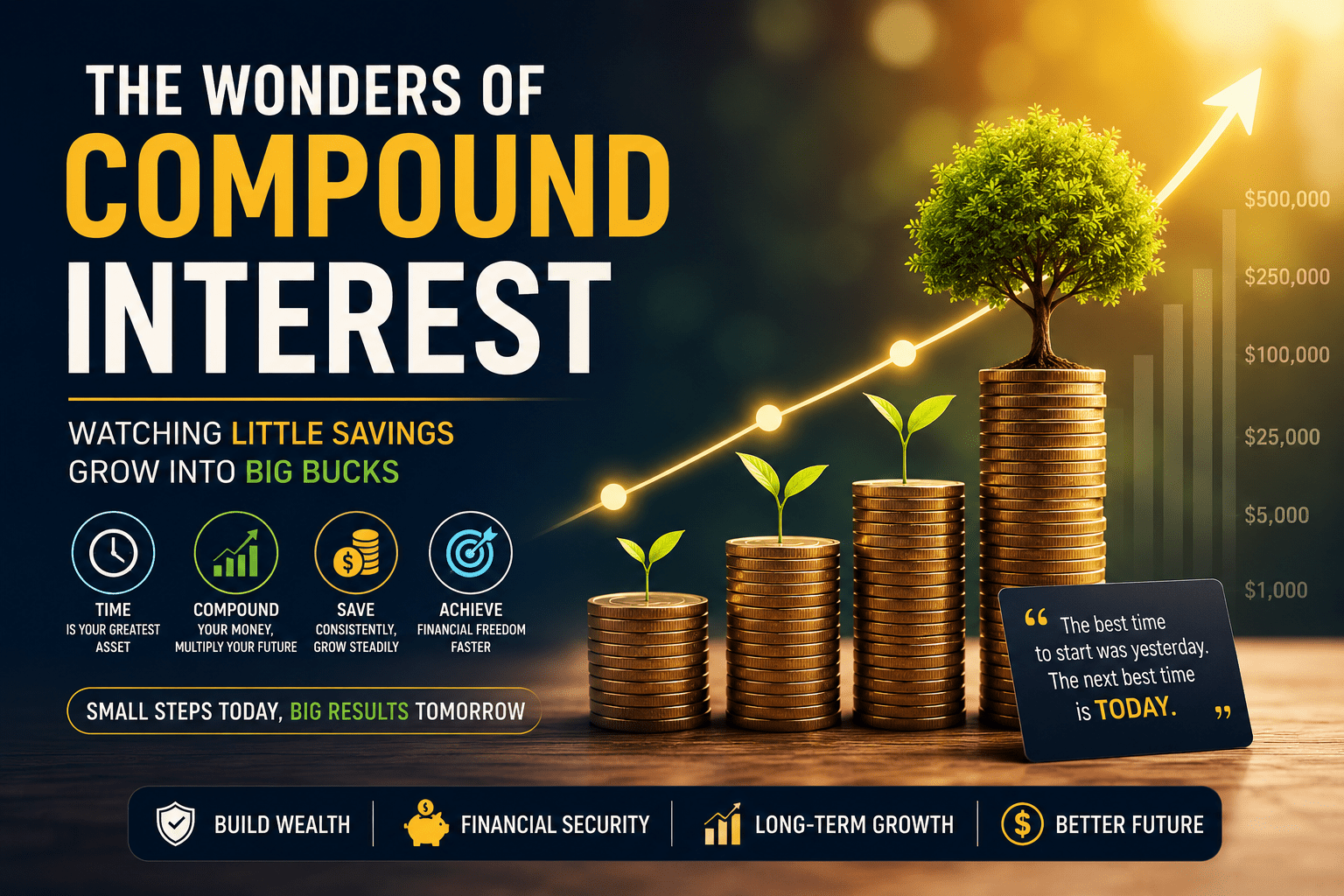
Imagine planting a tiny seed in your backyard. You water it regularly, give it sunlight, and patiently wait. Months later, it becomes a healthy tree, providing shade, beauty, and even fruit. Compound interest works in much the same way. Small, consistent savings may appear insignificant at first, but given enough time, they can grow into a substantial financial asset.
This simple financial principle has helped millions of people build emergency funds, prepare for retirement, purchase homes, and achieve long-term financial independence. It doesn’t require winning the lottery, earning a six-figure salary, or making risky investments. Instead, it rewards consistency, patience, and the habit of letting your money work for you.
Whether you’re saving your first $100 or already have thousands set aside, understanding compound interest is one of the smartest financial decisions you can make. In this guide, we’ll explain how it works, why it matters, and how you can harness its power to grow your wealth over time.
Key Takeaways
- Compound interest allows you to earn interest not only on your original savings but also on previously earned interest, accelerating your wealth over time.
- Starting to save early often has a greater impact than investing larger amounts later because time is the most powerful ingredient in compounding.
- Even small monthly contributions, such as $50 or $100, can grow into significant sums when invested consistently over many years.
- The Annual Percentage Yield (APY) and the frequency of compounding directly influence how quickly your savings grow.
- Reinvesting your earnings instead of withdrawing them helps maximize long-term growth.
- Compound interest benefits savers, investors, and retirement planners alike, making it one of the most effective tools for building financial security.
- Staying consistent, avoiding unnecessary withdrawals, and increasing your savings whenever possible can dramatically improve your long-term financial outcomes.
What Is Compound Interest?
Compound interest is the process of earning interest on both your original principal and the interest that has already been added to your account.
Unlike simple interest, which is calculated only on your initial deposit, compound interest continuously builds upon itself. As your balance increases, future interest payments are calculated on the larger amount, creating a powerful snowball effect.
Financial experts often call compound interest “interest on interest.” While that phrase sounds simple, its impact over decades can be extraordinary.
Consider this basic example:
- Initial Savings: $5,000
- Annual Interest Rate: 5%
- Compounded Annually
At the end of the first year, you earn interest on your $5,000. In the second year, interest is calculated on your new, larger balance rather than the original amount alone. Each year, your earnings generate additional earnings, causing your savings to grow at an accelerating pace.
The fundamental formula for compound interest is:
FV=PV(1+r)n
FV=PV(1+r)n=1000(1+0.05)20=$2,653.30
PV
$
PV
r
%
r
n
n
Compound Interest Calculator
$26,532.98
Total Interest:
Where:
- FV = Future Value
- PV = Present Value (Initial Deposit)
- r = Interest Rate per Period
- n = Number of Compounding Periods
Although the formula may seem technical, modern savings calculators and financial apps make it easy to estimate how your money could grow over time.
Why Compound Interest Is Called the “Eighth Wonder of the World”
A quote frequently attributed to Albert Einstein describes compound interest as the “eighth wonder of the world.” While historians debate whether he actually said it, the sentiment captures an important truth: compound interest is one of the most powerful concepts in personal finance.
The reason is simple. Unlike linear growth, compounding becomes stronger as time passes. In the early years, your account may seem to grow slowly. Over time, however, the accumulated interest begins earning additional interest, and the growth curve becomes increasingly steep.
For example:
- Saving $100 per month for one year may not seem life-changing.
- Continuing that habit for 10, 20, or 30 years while earning a reasonable annual return can result in a balance far greater than the total amount you deposited.
The longer your money remains invested or saved, the greater the compounding effect becomes.
Compound Interest vs. Simple Interest
Understanding the difference between compound and simple interest helps explain why compounding is so valuable.
| Feature | Compound Interest | Simple Interest |
|---|---|---|
| Interest Earned On | Principal + Previously Earned Interest | Principal Only |
| Growth Speed | Accelerates Over Time | Remains Constant |
| Long-Term Wealth Building | Excellent | Limited |
| Best For | Savings, Investments, Retirement Accounts | Some Short-Term Loans and Basic Interest Agreements |
Imagine depositing $10,000 at an annual interest rate of 5%.
With simple interest, you earn the same amount every year because interest is calculated only on the original deposit.
With compound interest, each year’s earnings are added to the balance, allowing future interest to be calculated on an increasingly larger amount.
Over several decades, this difference can amount to thousands—or even tens of thousands—of dollars, depending on the interest rate and contribution schedule.
The Four Factors That Drive Compound Growth
Compound interest is incredibly powerful, but its effectiveness depends on four key factors. Understanding these elements will help you make smarter financial decisions and maximize the growth of your savings.
1. Time
Time is the single most important ingredient in compound interest. The longer your money remains invested or saved, the greater the opportunity for your interest to generate additional interest.
For example:
- Person A starts saving $200 per month at age 25.
- Person B starts saving $200 per month at age 35.
Even if both earn the same annual return, Person A is likely to accumulate significantly more wealth because they gave their investments an extra decade to compound.
Lesson: Starting early often matters more than saving larger amounts later.
2. Interest Rate
The interest rate directly affects how quickly your money grows.
Consider a $10,000 investment over 20 years:
| Annual Return | Estimated Growth |
|---|---|
| 2% | Moderate |
| 4% | Stronger |
| 6% | Much Higher |
| 8% | Significant Long-Term Growth |
3. Regular Contributions
Compound interest becomes even more effective when you continue adding money to your savings.
Imagine saving:
- $100 every month
- $250 every month
- $500 every month
Each additional contribution not only increases your principal but also creates new opportunities for future interest to compound.
Automating your monthly savings can help you stay consistent and remove the temptation to skip contributions.
4. Compounding Frequency
Interest may be compounded:
- Daily
- Monthly
- Quarterly
- Semi-annually
- Annually
Generally, more frequent compounding results in slightly higher earnings because interest is added to your balance more often.
While the difference may seem small over one year, it becomes more meaningful over decades.
Why Starting Early Matters More Than Saving More
One of the biggest financial lessons is that time often beats amount.
Consider two savers:
Sarah
- Saves $200 per month
- Starts at age 22
- Continues for 30 years
David
- Saves $400 per month
- Starts at age 35
- Continues for 17 years
Although David contributes more each month, Sarah’s money has many more years to benefit from compound growth. In many scenarios, Sarah could end up with a larger balance despite investing less each month.
This example highlights why delaying your savings can be costly. Every year you wait is a year of compounding that you lose.
The Snowball Effect of Compound Interest
Compound interest is often compared to rolling a snowball down a hill.
At first, the snowball grows slowly.
As it continues rolling, it collects more snow, becoming larger and gaining momentum.
Your savings behave similarly.
During the first few years, growth may appear modest. Over time, however, previously earned interest begins generating its own returns, accelerating your financial progress.
This “snowball effect” is why long-term investing and consistent saving are so effective.
Real-Life Savings Example
Imagine Emma decides to open a high-yield savings account.
- Initial Deposit: $5,000
- Monthly Contribution: $200
- Annual Return: 5%
- Time Horizon: 20 Years
Instead of simply saving the money under her mattress or in a low-interest account, Emma allows her savings to earn compound interest.
Over time:
- Her own contributions steadily increase her balance.
- Interest is earned on every deposit.
- Previously earned interest also generates additional interest.
By remaining disciplined and avoiding unnecessary withdrawals, Emma could accumulate substantially more wealth than someone saving the same amount without earning competitive interest.
Compound Interest in Everyday Life
Compound interest isn’t limited to investment portfolios.
It can benefit many areas of personal finance, including:
Emergency Funds
A high-yield savings account allows emergency savings to grow while remaining easily accessible.
Retirement Accounts
Employer-sponsored retirement plans and individual retirement accounts often rely on decades of compound growth.
Education Savings
Parents who begin saving early for a child’s education may reduce the need for student loans later.
Long-Term Financial Goals
Compound interest can help fund:
- Home down payments
- Business ventures
- Major purchases
- Financial independence
Common Mistakes That Limit Compound Growth
Many people unintentionally reduce the benefits of compounding.
Avoid these common mistakes:
Waiting Too Long
Delaying your savings means losing valuable years of compound growth.
Withdrawing Interest Frequently
Removing earnings prevents them from generating additional returns.
Chasing Unrealistic Returns
Promises of unusually high returns often involve greater risks. Focus on steady, sustainable growth.
Ignoring Fees
High account fees can significantly reduce your long-term gains.
Inconsistent Saving
Skipping regular contributions slows the compounding process.
How Inflation Affects Compound Interest
Inflation gradually reduces your purchasing power over time.
For example:
If your savings earn 3% annually, but inflation averages 2%, your money is still growing in real terms—but by a smaller margin.
Choosing competitive savings or investment options can help your money keep pace with inflation over the long run.
Tips to Maximize Compound Interest
To make the most of compound interest:
- Start saving as early as possible.
- Contribute consistently, even if the amount is small.
- Reinvest all interest and dividends.
- Avoid unnecessary withdrawals.
- Compare savings accounts and investment options regularly.
- Increase your contributions whenever your income rises.
- Keep a long-term perspective and stay patient during market fluctuations.
Frequently Asked Questions
Q1. Is compound interest only for investments?
No. Many savings accounts, certificates of deposit (CDs), and certain retirement accounts also use compound interest.
Q2. How often should interest compound?
More frequent compounding—such as daily or monthly—can slightly increase your overall returns compared to annual compounding.
Q3. Can small savings really make a difference?
Absolutely. Consistent contributions combined with time and compound interest can lead to substantial financial growth.
Conclusion
Compound interest is one of the most valuable concepts in personal finance because it rewards patience, consistency, and long-term thinking. Whether you’re building an emergency fund, saving for retirement, or working toward a major financial goal, allowing your money to compound can significantly increase your wealth over time.
The journey to financial success doesn’t require large sums of money at the beginning. What matters most is developing the habit of saving regularly and giving your investments enough time to grow. Even modest monthly contributions can turn into impressive amounts when combined with the power of compound interest.
As economic conditions and interest rates continue to evolve, choosing competitive savings accounts or well-diversified investments becomes increasingly important. Regularly reviewing your financial plan, minimizing unnecessary fees, and reinvesting your earnings can further strengthen your long-term results.
Ultimately, compound interest proves that wealth is often built gradually rather than overnight. By starting today—even with a small amount—you give yourself the greatest advantage: time. The earlier you begin, the more opportunities your money has to work for you, helping transform small, consistent savings into lasting financial security.
References
The following trusted resources provide additional information on compound interest, savings, investing, and personal finance:
- Consumer Financial Protection Bureau (CFPB)
https://www.consumerfinance.gov/ - Federal Deposit Insurance Corporation (FDIC) – Banking and Savings Resources
https://www.fdic.gov/ - National Credit Union Administration (NCUA)
https://www.ncua.gov/ - U.S. Securities and Exchange Commission – Investor.gov
https://www.investor.gov/ - Federal Reserve – Financial Education and Monetary Policy
https://www.federalreserve.gov/ - Investopedia – Compound Interest Explained
https://www.investopedia.com/terms/c/compoundinterest.asp - NerdWallet – Savings and Personal Finance Guides
https://www.nerdwallet.com/ - Bankrate – Compound Interest Calculators and Financial Advice
https://www.bankrate.com/ - Forbes Advisor – Personal Finance Resources
https://www.forbes.com/advisor/ - The Balance Money – Saving, Budgeting, and Investing Guides
https://www.thebalancemoney.com/
Disclaimer: The examples in this article are for educational purposes only. Actual returns vary depending on interest rates, investment performance, account terms, fees, taxes, and market conditions. Always consult a qualified financial advisor or review the terms offered by your financial institution before making financial decisions.


Leave a Reply