


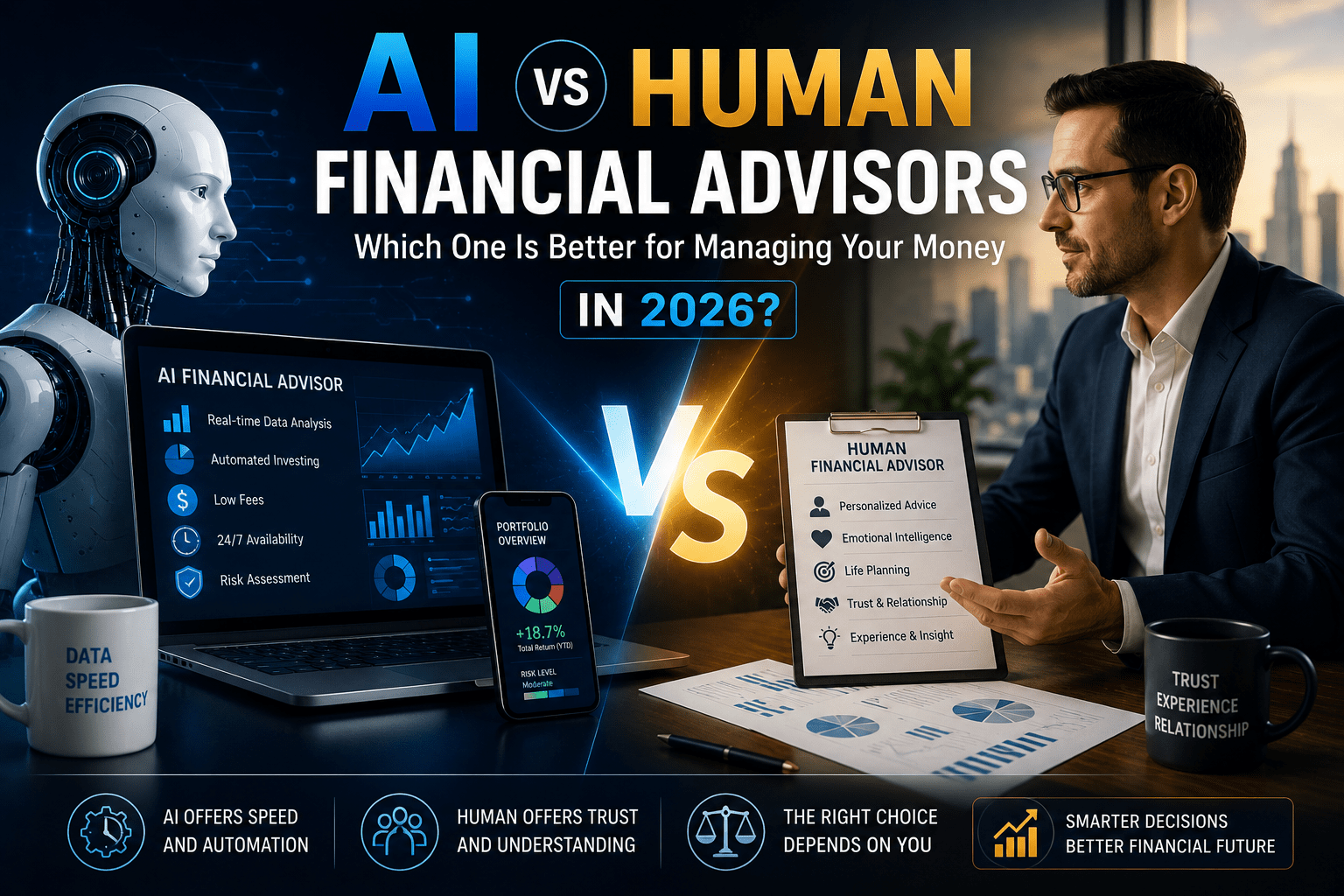
Introduction: The $1.8 Trillion Question
Walk into any coffee shop in 2026, and you will find two types of people managing their money. One is scrolling through a sleek app that just rebalanced their portfolio while they slept. The other is on a video call with a certified financial planner, discussing whether to exercise stock options before their company’s IPO. Both are making smart choices. Both are using professional-grade financial guidance. But only one of them is paying four times more for it.
The debate between AI and human financial advisors is no longer theoretical. Robo-advisors now manage over $1.8 trillion in assets in the United States alone, up from $1.4 trillion at the start of 2025 . AI adoption in financial services has reached 81% of surveyed firms, with 40% reporting advanced AI adoption at “Scaling” or “Transforming” stages . Meanwhile, nearly half of global consumers (49%) have used AI to support savings and investment decisions in the past six months .
Yet here is what the headlines miss: this is not a zero-sum game. AI advisors are not replacing human advisors any more than calculators replaced mathematicians. The real question is not “Which one wins?” but “Which one wins for you?” And in 2026, the answer depends entirely on your portfolio size, financial complexity, and what you actually need your money to do.
This article will give you a definitive, data-driven framework for making that decision. No marketing fluff. No generic advice. Just the facts, the fees, the performance data, and a clear path to choosing the right advisory approach for your specific situation.
The Three Models: Understanding What You Are Actually Choosing
Before we compare AI and human advisors, we need to clarify what we are comparing. In 2026, you have three distinct advisory models available—and understanding the difference between them is the first step to making the right choice.
1. Robo-Advisors: The Algorithmic Foundation
Robo-advisors like Betterment, Wealthfront, and Schwab Intelligent Portfolios use rule-based algorithms to build and automatically rebalance diversified portfolios. They are the original “AI” in wealth management, though the term is increasingly misleading because modern platforms have evolved far beyond simple portfolio construction.
Typical cost: 0.25% to 0.50% of assets annually (some offer free tiers)
What they do well: Low-cost, disciplined portfolio management, automatic rebalancing, tax-loss harvesting, and zero emotional decision-making.
What they do not do well: They cannot answer “Should I max my Roth IRA or pay down debt this year?” They do not know you hold $80,000 in employer RSUs creating concentration risk. They cannot coordinate your 401(k), equity compensation, and overall financial picture into a single coherent strategy .
2. AI Investment Advisors: The Conversational Evolution
This is the newer category that emerged in 2024-2025 and matured rapidly in 2026. Unlike traditional robo-advisors, AI investment advisors use large language models and machine learning to analyze your actual holdings, answer questions in plain English, and provide personalized guidance based on your connected accounts.
Typical cost: $8–$16 per month or a low percentage of assets
What they do well: Available 24/7, can answer portfolio-specific questions (“Is my portfolio too concentrated in tech?”), and provide personalized guidance without the cost of a human advisor.
What they do not do well: They are not fiduciaries in the legal sense. They cannot prepare your taxes, provide estate planning legal advice, or handle complex life transitions like divorce or business sales .
3. Human Financial Advisors: The Strategic Quarterback
Human advisors are licensed professionals—often CFPs (Certified Financial Planners) or CFAs (Chartered Financial Analysts)—who provide holistic financial planning across investments, taxes, estate planning, insurance, and life transitions.
Typical cost: 0.75% to 1.5% of assets annually, or flat fees ranging from $3,000 to $12,000 per year, or hourly rates of $250 to $600
What they do well: Complex tax optimization, estate planning, business owner strategies, behavioral coaching during market volatility, and coordinating multiple financial professionals (accountants, attorneys, insurance agents).
What they do not do well: They cannot monitor your portfolio daily for tax-loss harvesting opportunities. They cost significantly more. And quality varies dramatically between advisors .
The Cost Reality: What You Actually Pay vs. What You Actually Get
Let us be brutally honest about fees because this is where most people make their first mistake. The sticker price is never the full price.
AI and Robo-Advisor Costs
| Platform | Advisory Fee | Fund Expenses | Total Annual Cost on $250K |
|---|---|---|---|
| Vanguard Digital | $500 (0.20%) | ~$100 (0.04%) | $600 |
| Betterment Digital | $625 (0.25%) | ~$175 (0.07%) | $800 |
| Wealthfront | $625 (0.25%) | ~$200 (0.08%) | $825 |
| Schwab Standard | $0 | ~$75 (0.03%) | $75 + cash drag |
| Fidelity Go | $875 (0.35%) | $0 (0.00%) | $875 |
Source: Platform fee disclosures and industry analysis, 2026 Comparison Table
Here is the catch with Schwab’s “free” offering: the standard tier holds 6-12% of your portfolio in cash, which Schwab earns interest on. During a normal equity market, that cash drag costs approximately $800–$1,200 per year on a $250K portfolio—making the effective cost comparable to or higher than Betterment or Wealthfront .
Human Advisor Costs
| Fee Structure | Typical Range | Annual Cost on $500K |
|---|---|---|
| AUM (Assets Under Management) | 0.75% – 1.5% | $3,750 – $7,500 |
| Flat Annual Retainer | $3,000 – $12,000 | $4,000 – $8,000 |
| Hourly Rate | $250 – $600/hour | $2,500 – $5,000 (for 10-20 hours) |
| Project-Based | $2,000 – $6,000 | One-time fee |
Source: Domain Money 2026 Fee Guide Comparison Table
The Compounding Cost Trap
Here is the number that should keep you awake at night: on a $1 million portfolio over 20 years, the difference between a 1% AUM fee and a $6,000 flat fee exceeds $270,000 in cumulative costs. On a $2 million portfolio, that gap balloons to over $660,000 .
That is not a rounding error. That is a second home. That is a child’s college education. That is years of additional retirement income you are giving away because you chose the wrong fee structure.
When AI Advisors Absolutely Crush Human Advisors
Let us start with the scenarios where the data is unambiguous: AI wins, and it is not close.
1. Tax Optimization: The $200,000 Advantage
This is the single biggest advantage of AI advisors, and it is not even a contest.
Wealthfront’s direct indexing—which holds individual stocks instead of ETFs to maximize tax-loss harvesting opportunities—captures an additional 1.5% to 2.5% in “tax alpha” annually on portfolios over $500K . Over a 20-year period, that compounds into a difference of hundreds of thousands of dollars.
Here is why a human advisor cannot compete: a robo-advisor monitors 500+ individual stock positions across thousands of clients, harvesting losses daily or even intraday. A human advisor checking quarterly will miss the vast majority of these opportunities. It is not a skill gap. It is a bandwidth gap. No human can process that volume of data in real-time.
Betterment’s 2026 upgrade now harvests at the individual tax lot level rather than the account level, capturing even more tax savings for large portfolios . This is precision that human advisors simply cannot match.
2. Behavioral Discipline: Eliminating the 1-2% Behavior Tax
Dalbar’s annual study—one of the most respected longitudinal analyses in finance—consistently shows that the average investor underperforms their own funds by 1% to 2% annually due to behavioral mistakes: panic selling during downturns, chasing performance in rallies, trying to time the market .
AI advisors are immune to these biases. They rebalance mechanically. They invest according to plan. They do not get spooked by headlines, influenced by CNBC panic, or tempted to “wait for the market to bottom out.” Some platforms now delay sell orders by 24 hours during high-volatility periods and present historical recovery data to prevent emotional decisions .
If you have ever sold during a crash and regretted it six months later, you have paid the behavior tax. AI advisors eliminate most of it.
3. Consistent Rebalancing: The Set-It-and-Forget-It Advantage
Portfolios drift. A portfolio that started at 70% stocks and 30% bonds might drift to 80/20 after a strong equity year. Robo-advisors rebalance automatically, usually using new deposits and dividends to minimize tax impact. Human advisors often delay rebalancing—especially when it means calling a client to discuss selling winners .
The result? AI-managed portfolios stay closer to their target allocations, maintaining the risk profile you originally chose. Human-managed portfolios often drift into unintended risk levels because rebalancing conversations are uncomfortable.
4. Cost Efficiency for Standard Situations
For a straightforward investment situation—saving for retirement with a diversified portfolio, no complex tax issues, no business income, no stock options—paying 0.25% versus 1.00% is a mathematical slam dunk for AI.
On a $500K portfolio over 30 years, the fee difference compounds to over $200,000 in additional wealth . That assumes identical gross returns. In reality, AI advisors often deliver better after-tax returns due to superior tax optimization, widening the gap even further.
When Human Advisors Are Worth Every Penny
Now for the other side of the coin. There are situations where a human advisor delivers value that no algorithm can replicate, and paying 1% is not just justified—it is a bargain.
1. Complex Tax Situations
If you have stock options, restricted stock units (RSUs), carried interest, rental properties, business income, or significant concentrated stock positions, the tax planning requires judgment that current AI systems cannot fully replicate.
A skilled tax-focused financial planner can save six figures through strategies like:
- Charitable remainder trusts for highly appreciated stock
- Qualified small business stock (QSBS) exclusions for startup equity
- Roth conversion laddering during low-income years
- Net unrealized appreciation (NUA) strategies for company stock in a 401(k)
These strategies require understanding your complete tax picture, family situation, and long-term goals. AI can model the numbers, but the planning requires human judgment .
2. Major Life Transitions
Divorce. Inheritance. Business sale. Disability. Death of a spouse. These situations involve financial, legal, and emotional complexity that requires a human who can listen, empathize, and coordinate with attorneys and accountants.
No robo-advisor will sit with you at 2 AM while you process a spouse’s death and explain how survivor benefits work. No AI will mediate a conversation between divorcing partners about dividing retirement accounts. No algorithm will hold your hand while you decide whether to sell the family business your grandfather built .
3. Estate Planning and Multigenerational Wealth
Multigenerational wealth transfer, trust structures, family limited partnerships, generation-skipping trusts—these require customized strategies that account for family dynamics, state laws, and long-term goals. AI can model the numbers, but the planning requires human judgment about family relationships, values, and succession intentions .
4. Business Owner Finances
If you own a business, your financial life is entangled with the business in ways that robo-advisors cannot address:
- Compensation strategy: Salary vs. distributions vs. dividends
- Retirement plan design: SEP-IRA vs. Solo 401(k) vs. defined benefit plan
- Business succession planning
- Key person insurance
- Qualified business income (QBI) deduction optimization
These require integrated advice that considers both personal and business tax implications. AI cannot yet handle this level of complexity .
5. Accountability and Behavioral Coaching
Some people need a human to call them and say, “You are not saving enough” or “Let’s talk about why you have not updated your beneficiaries.” The accountability function of a human advisor is real and valuable for people who otherwise would not take action.
Research shows that AI-driven behavioral nudges increase average client savings rates by 7%, but for some individuals, a human relationship is the only thing that creates lasting behavioral change .
Platform Deep Dive: The Best AI Advisors of 2026
Betterment: The Most Well-Rounded
AUM: $45B+ | Minimum: $0 (Digital), $100K (Premium) | Fee: 0.25% (Digital), 0.65% (Premium)
Betterment remains the most balanced AI advisory platform. The Digital tier provides automated portfolio management, tax-loss harvesting, and goal-based planning. The Premium tier adds unlimited access to certified financial planners via video call—creating a genuine hybrid experience .
2026 upgrades: Multi-goal optimization (balancing retirement savings, house down payment, and college funding simultaneously) and tax-lot-level harvesting .
Best for: Investors who want excellent goal-based planning with the option to upgrade to human advice.
Wealthfront: The Tax Optimization King
AUM: $52B+ | Minimum: $500 | Fee: 0.25%
Wealthfront has positioned itself as the technology leader. Its direct indexing for accounts over $100K captures 2-4x more tax losses than ETF-based harvesting. The “autopilot” feature monitors cash flow and automatically moves excess cash into investments .
2026 upgrades: Integration with over 11,000 financial institutions and enhanced AI financial planning engine .
Best for: Taxable accounts over $100K where direct indexing can deliver significant value.
Vanguard Digital Advisor: The Lowest-Cost Leader
AUM: $310B+ | Minimum: $3,000 | Fee: 0.20% (Digital), 0.30% (Personal Advisor)
Vanguard has the lowest advisory fee among major platforms. The Personal Advisor tier at 0.30% combines AI-driven portfolio management with access to human advisors—an exceptional value for hybrid service .
2026 upgrades: Dynamic withdrawal strategies for retirement income and Social Security optimization tool .
Best for: Cost-conscious investors who want Vanguard’s ultra-low-cost index funds with optional human guidance.
Schwab Intelligent Portfolios: The “Free” Option (With a Catch)
AUM: $80B+ | Minimum: $5,000 (Standard), $25,000 (Premium) | Fee: $0 (Standard), $30/month (Premium)
Schwab’s standard tier charges no advisory fee. The trade-off: a higher cash allocation (typically 6-12%) which creates a hidden cost through opportunity loss .
2026 upgrades: Dynamic cash allocation based on interest rate conditions and upgraded scenario modeling for Premium tier .
Best for: Investors who want zero explicit fees and do not mind the cash drag trade-off.
Fidelity Go: The Best for Beginners
AUM: $28B+ | Minimum: $0 | Fee: $0 (under $25K), 0.35% ($25K+)
Fidelity Go uses Fidelity’s own zero-expense-ratio index funds, making the total investment cost among the lowest available. Free for accounts under $25K .
2026 upgrades: AI-powered retirement income planning integrated with Fidelity workplace retirement plans .
Best for: Beginning investors who want to start with zero fees and graduate to more sophisticated planning.
Performance Data: Do AI Advisors Actually Deliver?
This is the question everyone asks, and the answer is more nuanced than headlines suggest.
The Performance Comparison (Moderate Risk, 3-Year Annualized Returns Through Q1 2026)
| Platform | 1-Year Return | 3-Year Annualized | 5-Year Annualized |
|---|---|---|---|
| Betterment (moderate) | 12.4% | 8.7% | 9.2% |
| Wealthfront (moderate) | 12.8% | 8.9% | 9.4% |
| Schwab (moderate) | 10.9% | 7.8% | 8.5% |
| Fidelity Go (moderate) | 11.6% | 8.2% | 8.8% |
| Vanguard Digital (moderate) | 11.8% | 8.4% | 9.0% |
| S&P 500 (benchmark) | 16.2% | 11.1% | 12.3% |
Source: Platform performance disclosures and industry analysis Comparison Table
Critical context: All robo-advisors hold diversified portfolios (US stocks, international stocks, bonds, real estate), so they will underperform a pure US equity benchmark during US bull markets and outperform during downturns. The variation between platforms (8.7% to 8.9% over 3 years) is largely a function of asset allocation differences, not AI quality .
Schwab’s lower returns are primarily explained by the cash drag. Adjust for the cash allocation, and Schwab’s invested portfolio performance is comparable to the others.
The Real Performance Advantage: After-Tax Returns
Where AI advisors truly shine is not in gross returns but in after-tax returns. Wealthfront’s direct indexing clients capture an additional 1.5-2.5% in tax alpha annually. Betterment’s tax-coordinated portfolio across multiple account types optimizes asset location. These are not reflected in the headline performance numbers but show up in your actual account balance at tax time .
The Behavioral Advantage: Preventing Self-Inflicted Wounds
The most significant performance advantage of AI advisors is not what they add—it is what they prevent. By eliminating panic selling, performance chasing, and market timing, AI advisors protect investors from the 1-2% annual behavior tax that destroys human-managed returns .
In volatile markets, this advantage compounds. During the 2022 downturn, investors with AI-managed portfolios were significantly more likely to stay the course than those managing their own investments or working with human advisors who had to actively talk them off the ledge.
The Decision Framework: Which Advisor Is Right for You?
By Portfolio Size
| Portfolio Size | Recommended Approach | Why |
|---|---|---|
| Under $25K | Fidelity Go (free) or Betterment | Fees matter most at small portfolio sizes. Do not pay a human advisor 1% on a $20K portfolio. |
| $25K–$100K | Betterment or Vanguard Digital | AI handles all standard investment needs. Fee savings compound significantly over time. |
| $100K–$500K | Wealthfront (for direct indexing) or Betterment | Tax-loss harvesting through direct indexing starts adding significant value. |
| $500K–$2M | Hybrid approach | Use a robo-advisor for portfolio management and tax optimization. Hire a fee-only planner ($2K–$5K/year) for annual planning review. |
| $2M–$10M | Vanguard Personal Advisor or fee-only advisor + robo | Financial complexity increases. Estate planning and multi-account coordination benefit from human expertise. |
| $10M+ | Dedicated human advisor or multi-family office | At this level, the advisory fee is justified by the complexity and absolute dollar value of optimization opportunities. |
Source: AI MagicX 2026 Analysis Comparison Table
By Financial Complexity
| Situation | AI Advisor | Human Advisor | Hybrid |
|---|---|---|---|
| Salaried W-2 employee, saving for retirement | Best choice | Overkill | Not needed |
| Dual-income household, multiple goals | Best choice | Optional | Good option |
| Self-employed, variable income | Possible | Recommended | Best choice |
| Business owner with employees | Insufficient | Best choice | Good option |
| Stock options or RSUs | Insufficient | Best choice | Good option |
| Recent inheritance ($500K+) | Possible | Recommended | Best choice |
| Approaching retirement (within 5 years) | Good | Recommended | Best choice |
| Already retired, managing withdrawals | Possible | Recommended | Best choice |
| Going through divorce | Insufficient | Required | N/A |
| Significant charitable giving | Insufficient | Best choice | Good option |
Source: AI MagicX 2026 Analysis Comparison Table
The Hybrid Approach: Getting the Best of Both Worlds
The smartest strategy for most people in 2026 is not choosing between AI and human advisors. It is combining them strategically.
The Optimal Hybrid Setup
Step 1: Use a robo-advisor for portfolio management. Let AI handle asset allocation, rebalancing, tax-loss harvesting, and day-to-day investment management. Betterment or Wealthfront for taxable accounts. Keep your 401(k) and IRA wherever the fund options and fees are best .
Step 2: Hire a fee-only financial planner for strategic advice. Find a CFP who charges a flat fee or hourly rate rather than a percentage of assets. Expect to pay $2,000–$6,000 per year for an annual comprehensive financial plan with quarterly check-ins .
Step 3: Use AI planning tools for ongoing decisions. Between human advisor meetings, use the AI planning features in your robo-advisor to model scenarios: “What if I increase my 401(k) contribution by 5%?” or “How does buying this rental property affect my retirement timeline?” .
Step 4: Reserve human advisor time for complex decisions. Use your financial planner for the big decisions: Roth conversions, stock option exercise strategies, insurance reviews, estate plan updates, and major purchase analysis .
The Cost Advantage
This hybrid approach typically costs 0.25% (robo) + $3,000–$5,000/year (planner), which is significantly less than a traditional advisor charging 1% of AUM while delivering better outcomes in both tax optimization and strategic planning .
On a $750K portfolio, that is roughly $4,875–$6,875 per year versus $7,500 for a traditional AUM advisor. On a $1.5M portfolio, the savings become dramatic: $6,750–$8,750 versus $15,000 .
The Limitations: What AI Advisors Cannot Do (Yet)
The Hallucination Problem
Large language models are built to produce plausible text, not verified truth. In personal finance, this is dangerous. An AI can state a wrong number with total confidence: a misread tax bracket, an incorrect Social Security claiming age, or investment advice that ignores your specific tax situation .
The rule for 2026: Never act on AI financial advice without verification. If an AI suggests moving $50,000, check the math yourself. If it recommends an investment, confirm with a second source.
Context Blindness
No AI tool automatically knows your full financial picture unless you give it everything. It does not know your tax bracket, your employer’s 401(k) match, your debt interest rates, or your risk tolerance unless you explicitly provide them .
AI advice is only as good as the data you feed it. Garbage in, garbage out. The most expensive mistake you can make is assuming an AI understands your situation when it only knows what you have told it.
Regulatory and Fiduciary Gaps
Most AI finance tools are not fiduciaries. They are not legally required to act in your best interest. They may recommend products that earn them commissions. They may prioritize engagement over your financial health .
Until regulatory frameworks catch up with AI capabilities, the responsibility for verifying advice remains squarely on you.
The “Advice Gap” for Lower-Net-Worth Individuals
While AI advisors have democratized access to portfolio management, a significant gap remains for people who need holistic financial planning but cannot afford a human advisor. 58% of UK financial advisors believe AI will help narrow this advice gap for lower-net-worth individuals, but we are not there yet .
The Future: Where Advisory Models Are Headed
AI Agents, Not Just Assistants
The next evolution beyond 2026 is AI agents that can take action on your behalf—not just suggest, but execute. Imagine an AI that automatically negotiates your bills, rebalances your portfolio in response to market shifts without you logging in, and files your taxes by pulling data from all your accounts .
Agentic AI is already in active adoption among 52% of industry respondents, with 23% at mature “Scaling or Transforming” stages. Fintechs lead traditional institutions 57% to 45% in agentic AI adoption .
The Human Advisor’s Evolving Role
As AI handles the mechanical work, human advisors are pivoting to what AI cannot do: deep relationship building, complex life transition guidance, and high-stakes judgment calls. The advisor of 2030 will spend less time rebalancing portfolios and more time helping clients navigate inheritance conversations with their children or designing charitable giving strategies that reflect their values.
Regulatory Evolution
With 74% of financial institutions having appointed or intending to appoint senior executives for AI ethics and governance, the regulatory framework is catching up . Expect clearer fiduciary standards for AI advisors, mandatory disclosure of AI limitations, and enhanced consumer protection frameworks by 2027-2028.
Common Mistakes to Avoid
Mistake 1: Paying 1% for What a Robo-Advisor Does for 0.25%
If your human advisor’s primary value is portfolio management and rebalancing, you are overpaying. That value has been automated. The only justification for a 1% fee is comprehensive planning, tax optimization, and behavioral coaching that genuinely adds value beyond what AI can deliver .
Mistake 2: Choosing a Robo-Advisor Based on Past Returns
Performance differences between major robo-advisors are small and not persistent. Choose based on features, fees, and tax optimization capabilities—not who had the best quarter .
Mistake 3: Ignoring the Cash Drag
Schwab’s “free” portfolio is not free if 8% of your money sits in cash earning below-market returns. Calculate the actual cost before choosing based on sticker price .
Mistake 4: Skipping Tax-Loss Harvesting
If you have a taxable account over $50K, you should be on a platform that offers automated tax-loss harvesting. The value is real and measurable—often 1-2% in additional after-tax returns annually .
Mistake 5: Using a Robo-Advisor for a Complex Situation
If you have business income, stock options, or significant estate planning needs, the savings from a lower fee are dwarfed by the value of proper planning. Do not let cost optimization become wealth destruction .
Conclusion
The AI versus human advisor debate is a false binary. Here is the truth, stripped of marketing and bias:
AI financial advisors are unambiguously better for:
- Portfolio management and rebalancing
- Tax optimization and tax-loss harvesting
- Behavioral discipline during market volatility
- Cost-efficient management of straightforward portfolios
- 24/7 availability for questions and scenario modeling
Human financial advisors are unambiguously better for:
- Complex tax situations and estate planning
- Major life transitions requiring empathy and judgment
- Business owner finances and compensation strategy
- Multigenerational wealth transfer
- Accountability and behavioral coaching for people who need human connection
For most people with straightforward finances and portfolios under $500K, an AI advisor is the right primary choice. The fee savings alone—compounded over decades—can fund years of additional retirement income.
For business owners, high-net-worth individuals, and anyone navigating financial complexity, a hybrid approach delivers the best outcomes. Use AI for what it does best (portfolio management, tax optimization) and humans for what they do best (strategic planning, life transitions).
The one thing that is never the right choice is paying a human advisor 1% of your assets primarily to do what an algorithm does better and cheaper. If your advisor’s value proposition is “we rebalance your portfolio and pick diversified funds,” you are paying a premium for a commodity.
The future of financial advice is not AI replacing humans or humans resisting AI. It is each doing what they do best, with smart investors combining both to build wealth more efficiently than either could alone.
Your money deserves the right tool for the job. Choose wisely.
References and External Links
- Cambridge Centre for Alternative Finance – 2026 Global AI in Financial Services Report
- EY Global AI Sentiment Survey 2026 – “Nearly half of global consumers now use AI to guide savings and investment decisions”
- AI MagicX – “AI Financial Advisors vs Human Advisors in 2026”
- Astor – “AI Financial Advisors vs. Human Advisors vs. Robo-Advisors in 2026”
- 8Figures – “Robo-Advisor vs. Financial Advisor vs. AI (2026)”
- Domain Money – “How Much Does a Financial Advisor Cost? Complete 2026 Fee Guide”
- The Madison Partners – “Human Advisor vs Robo-Advisor in 2026”
- Flat Fee Advisors – “Hiring a Financial Advisor in 2026”
- WiFi Talents – “AI In The Financial Planning Industry Statistics”
- Precedence Research – “AI Agents in Financial Services Market Size”
- FII International – “Report finds uneven AI adoption in financial services”
- Schwab Advisor Services – “Schwab Study Reveals RIA AI Adoption More Than Doubles”


Leave a Reply