


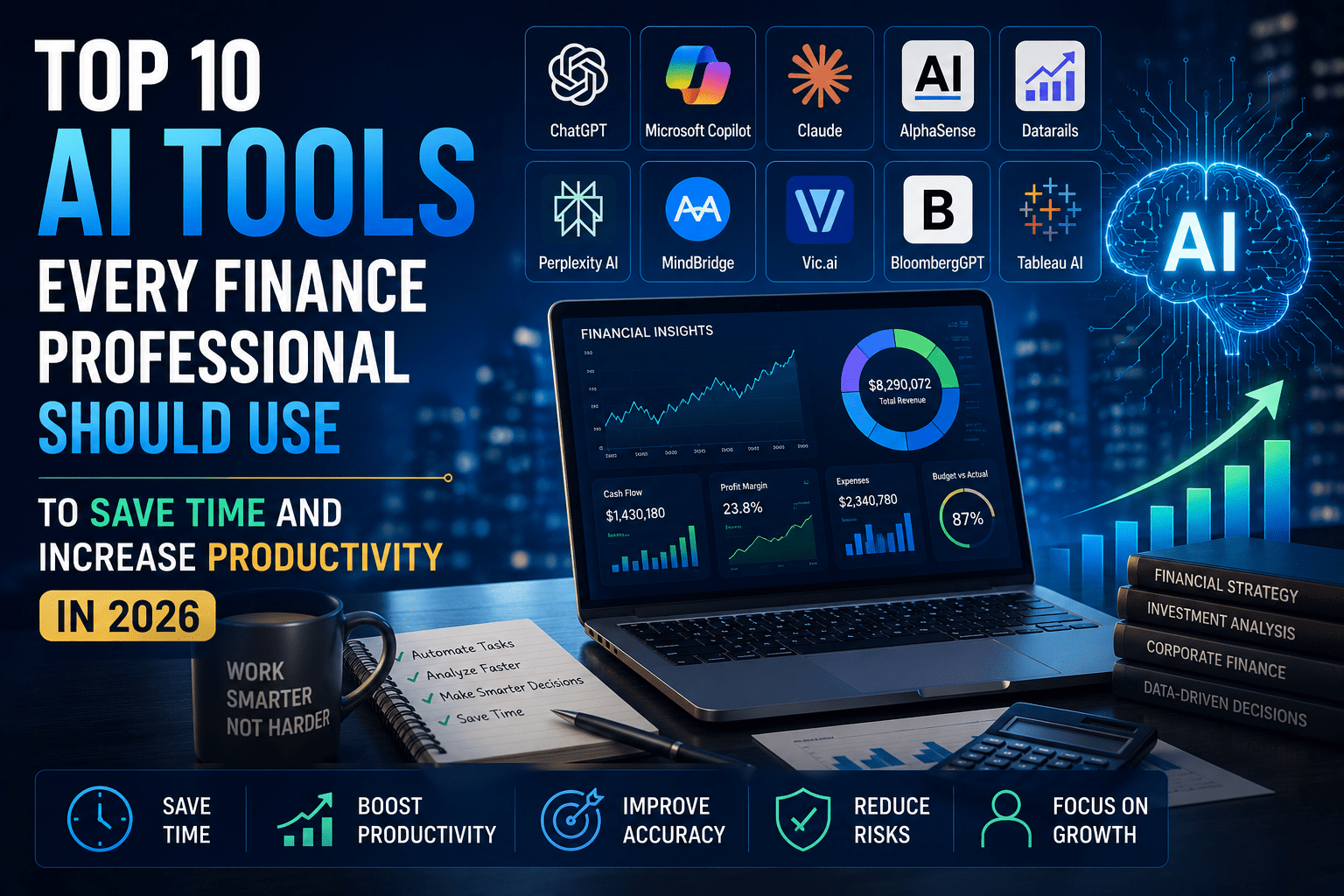
Introduction: The 60% Time Tax on Finance Professionals
Here is a number that should terrify every finance professional: up to 60% of your workweek is spent on data gathering, reconciliation, and manual documentation — tasks that artificial intelligence can now handle in minutes. According to McKinsey’s analysis on AI in finance functions, the majority of finance team time is consumed by repetitive operational work that adds minimal strategic value .
In 2026, this is not just an efficiency problem. It is a competitive disadvantage. While your competitors leverage AI to compress hours of work into seconds, manual workflows leave you buried in spreadsheets at midnight, missing the strategic conversations where real career advancement happens.
The good news? The AI tools available today are not experimental prototypes. They are production-ready platforms trusted by Fortune 500 companies, Big 4 accounting firms, and the world’s largest investment banks. Deloitte’s 2025 CFO Signals survey found that variance analysis and management reporting remain the highest-effort, lowest-value use of finance team time — precisely the workflows that modern AI is designed to eliminate .
This article is not a generic list of “cool AI tools.” It is a battle-tested toolkit for finance professionals who want to reclaim their time, elevate their strategic impact, and future-proof their careers. Each tool on this list has been evaluated against real-world finance workflows, verified against 2026 product capabilities, and selected for its ability to deliver measurable productivity gains — not marketing hype.
Whether you are a financial analyst building models, an advisor managing client relationships, an accountant processing transactions, or a CFO steering strategy, these ten tools will fundamentally change how you work.
The State of AI in Finance: What Changed in 2026
Before diving into the tools, understand the landscape. Three shifts have made 2026 the inflection point for AI adoption in finance:
1. From Experimentation to Production Deployment
AI in finance has moved decisively from pilot programs to core infrastructure. According to the 2026 Global AI in Financial Services Report by Cambridge Judge Business School, 81% of financial services firms have adopted AI at some level, with 40% already at advanced “Scaling” or “Transforming” stages . Protiviti’s 2025 Global Finance Trends Survey found that 72% of finance organizations are now using AI — up from just 34% the prior year .
2. Agentic AI: From Assistance to Autonomous Action
The most significant shift in 2026 is the rise of agentic AI — systems that do not just answer questions but autonomously execute multi-step workflows. These AI agents monitor data continuously, detect anomalies without prompting, investigate root causes, and deliver actionable insights before you ask . This is not chatbot technology. It is a fundamentally different paradigm that transforms finance from reactive reporting to proactive intelligence.
3. The Productivity Imperative
With talent shortages, regulatory complexity, and client expectations rising simultaneously, finance professionals cannot afford to spend their days on mechanical work. The firms winning in 2026 are those that have redeployed human expertise toward judgment, strategy, and relationships — while letting AI handle the rest.
Tool #1: Tellius — Automated Variance Investigation & Agentic FP&A Analytics
Best For: FP&A teams, financial analysts, and CFOs who need to explain why numbers changed — not just that they did.
Category: AI-Powered Financial Analytics
Pricing: Enterprise (custom pricing based on data volume and users)
If there is one tool that defines the 2026 finance technology stack, it is Tellius. While most platforms tell you what changed in your financials, Tellius is purpose-built to explain why — decomposing variance into quantified drivers (price, volume, mix) across every connected data source, in seconds rather than days .
What It Does
Tellius deploys AI agents that monitor your financial KPIs 24/7, autonomously detect budget-versus-actual anomalies, investigate root causes without human prompting, and deliver board-ready narratives with quantified explanations. Ask “Why did gross margin compress in Q3?” and receive a complete P/V/M decomposition with ranked driver attribution across cost centers, product lines, and geographies — all exportable to PowerPoint, Excel, or PDF .
The Productivity Impact
Traditional variance analysis consumes 3–5 days of manual pivot table work per investigation. Tellius reduces this to seconds. For a mid-sized FP&A team running 20 variance investigations monthly, that is 400–600 hours reclaimed — equivalent to adding three full-time analysts without hiring anyone.
Why It Made the List
Tellius is the only platform in the 2026 market with full marks across automated root cause decomposition, agentic monitoring, conversational analytics, and narrative generation simultaneously. Recognized as a Gartner Magic Quadrant Visionary for five consecutive years (2022–2026), it is trusted by Novo Nordisk, AbbVie, Regeneron, PepsiCo, and P&G .
Key Integration: Connects to SAP, Oracle, NetSuite, Snowflake, Databricks, Salesforce, Anaplan, and Workday Adaptive without replacing any existing infrastructure.
Tool #2: Jump AI — Meeting Intelligence & Client Workflow Automation
Best For: Financial advisors, wealth managers, and client-facing finance professionals.
Category: AI Meeting Intelligence & CRM Automation
Pricing: $75–$175/user/month
The average financial advisor spends hours each week on meeting prep, note-taking, and follow-up — administrative work that generates zero revenue. Jump AI eliminates up to 90% of this busywork by automating the entire meeting lifecycle .
What It Does
Before a client call, Jump pulls data from your CRM, portfolio management system, tax records, and estate documents to generate a comprehensive pre-meeting briefing. During the meeting, it captures the conversation, drafts structured notes, identifies action items, and turns them into Smart Tasks. Afterward, it drafts follow-up emails and injects everything into your CRM — automatically .
The Productivity Impact
One network of 70 advisors using automated meeting documentation saves 1,400 hours monthly — equivalent to £42,000 in cost savings per month . For a solo advisor, that is 10–15 hours per week reclaimed for client-facing work, business development, or simply going home on time.
Why It Made the List
Jump is the only meeting intelligence platform built specifically for financial advisors, with native compliance safeguards, audit trails, and CRM integrations (Salesforce, Redtail, Wealthbox) that generic note-taking tools cannot match .
Key Integration: Syncs with Salesforce, Redtail, Wealthbox, Zoom, Microsoft Teams, and Google Meet.
Tool #3: Claude (Anthropic) — Secure Document Synthesis & Deep Reasoning
Best For: Investment bankers, analysts, and compliance officers handling sensitive documents.
Category: Secure Generative AI for Financial Analysis
Pricing: Free tier available; Pro at $20/month; Enterprise custom
When Wall Street Prep tested four leading AI financial modeling tools by building Apple’s three-statement model, Claude ranked second overall — significantly outperforming ChatGPT and Microsoft Copilot . But Claude’s real advantage for finance professionals is not just accuracy. It is security.
What It Does
Claude processes up to 500 pages of text in a single prompt, making it ideal for reviewing diligence documents, summarizing earnings transcripts, and comparing deal materials. Critically, Anthropic’s enterprise-grade security and data-control policies prevent your confidential information from being used to train third-party models — a non-negotiable for regulated financial work .
In 2026, Anthropic introduced pre-built finance agents that automate pitchbook creation and earnings reviews directly within Microsoft 365, with specialized data connectors including Moody’s integration for credit ratings .
The Productivity Impact
A single complex due diligence review that previously required 20+ hours of manual document review can now be completed in 2–3 hours with Claude-assisted synthesis. For M&A teams running multiple deals simultaneously, this compounds into weeks of reclaimed time per quarter.
Why It Made the List
No other general-purpose AI combines Claude’s reasoning depth with its security posture. For finance professionals handling material non-public information (MNPI), this is the only safe choice among consumer-grade AI tools.
Key Integration: Microsoft 365, Slack, Notion, and enterprise apps via API.
Tool #4: Holistiplan — AI Tax Planning in Under 60 Seconds
Best For: Tax professionals, financial planners, and advisors who need rapid tax return analysis.
Category: AI-Powered Tax Planning
Pricing: $149/month or $1,499/year
Tax planning is one of the highest-value, most time-consuming activities in financial services. Holistiplan has captured 39% market share in advisor tax planning tools by doing one thing exceptionally well: reading client tax returns and surfacing planning opportunities in under 60 seconds .
What It Does
Upload a client’s 1040, and Holistiplan’s AI extracts every relevant data point, identifies missed deductions, flags Roth conversion opportunities, analyzes marginal rate cliffs, and generates a professional tax planning report — all before you finish your coffee .
The Productivity Impact
Manual tax return analysis takes 2–4 hours per client. Holistiplan compresses this to under a minute. For a practice with 200 tax-planning clients, that is 400–800 hours annually redirected toward higher-value advisory conversations.
Why It Made the List
With 50,000+ users across the advisory industry, Holistiplan has proven that AI tax planning is not a novelty — it is a practice-transforming capability. It integrates cleanly with Zocks for seamless meeting-to-analysis workflow, creating a closed loop from client conversation to tax strategy .
Key Integration: Zocks, Wealthbox, Redtail, Salesforce, and most major planning platforms.
Tool #5: RightCapital — AI-Driven Financial Planning & Tax Optimization
Best For: Fee-only advisors, retirement planners, and comprehensive financial planners.
Category: AI-Powered Financial Planning
Pricing: $125–$150/month
RightCapital has evolved from a solid planning platform into an AI-driven analytical powerhouse. Where it truly excels is in the complex, multi-variable analyses that used to consume hours of advisor time: Roth conversion modeling, Social Security optimization, and tax projections .
What It Does
RightCapital’s AI layer surfaces optimal strategies by modeling 20 simultaneous Roth conversion scenarios with bracket management, analyzing 9,000+ Social Security claiming combinations for couples, and projecting tax implications across decades. The platform’s “Penny” AI assistant answers client questions about Roth conversions and IRMAA during meetings — with verified math, not guesswork .
The Productivity Impact
A comprehensive retirement income plan that previously required 8–12 hours of manual modeling now takes 2–3 hours of review and client communication. For advisors charging $3,000–$8,000 per advisory engagement, this efficiency gain directly improves margins and capacity .
Why It Made the List
RightCapital is the #1 retirement distribution planning tool by market share for three consecutive years (2024–2026) according to the T3/Inside Information Advisor Software Survey . Its AI integration is not bolted on — it is woven into the core planning engine.
Key Integration: Most major custodians, tax software, and CRM platforms.
Tool #6: V7 Go — Intelligent Document Processing for Financial Workflows
Best For: Operations teams, compliance officers, and anyone drowning in financial documents.
Category: AI Document Automation
Pricing: Enterprise (custom pricing)
Financial services runs on documents — loan applications, KYC bundles, fund statements, insurance claims, regulatory filings. Processing these manually is not just slow; it is expensive. Manual invoice processing costs an average of $9.40 per document; best-in-class automated processing costs $2.36 .
What It Does
V7 Go is an AI agent platform that captures, classifies, extracts, validates, and routes financial documents without manual intervention. Unlike legacy OCR tools that fail when document formats change, V7 Go’s large language models reason about document content — understanding that a number is a revenue figure, a name is a counterparty, or a clause modifies indemnification terms .
For investment managers, it processes data rooms at the document level, extracting and cross-referencing key facts across hundreds of files. For banks, it reduces commercial loan processing from 6–8 hours to under 30 minutes per application .
The Productivity Impact
A mid-sized fund manager processing 500 invoices monthly saves over $60,000 annually in processing costs alone, plus 200+ hours of staff time redirected to higher-value work .
Why It Made the List
V7 Go represents the new generation of AI-native document processing that generalizes across formats without rule adjustments. For financial institutions where document variety is the norm, this is the difference between automation that works and automation that breaks.
Key Integration: API and webhook connectivity to core banking platforms, CRM systems, loan origination software, and ERP platforms.
Tool #7: MindBridge — AI-Powered Audit Risk Detection
Best For: Internal auditors, compliance teams, and risk managers.
Category: AI Audit & Risk Analytics
Pricing: Enterprise (custom pricing)
Traditional audit sampling examines a tiny fraction of transactions and hopes to catch anomalies. MindBridge applies machine learning to full populations — analyzing every general ledger entry to surface risk patterns that sampling misses entirely .
What It Does
MindBridge’s ensemble AI scores every transaction for risk, segments anomalies by subsidiary and user, and delivers GPU-accelerated detection. One published case uncovered $85 million in mispostings that sampling-based approaches had completely missed .
The Productivity Impact
Audit teams using MindBridge report dramatic reductions in false positives and investigation time. Instead of chasing hundreds of irrelevant alerts, auditors focus on the genuinely anomalous transactions — often fewer than 20 per population — with full context for investigation.
Why It Made the List
All Big 4 accounting firms use DataSnipper (MindBridge’s document extraction counterpart) for audit evidence management. The combination of MindBridge for risk detection and DataSnipper for evidence extraction represents the most advanced AI audit stack available in 2026 .
Key Integration: Databricks, Microsoft Fabric, Snowflake, and major ERP systems.
Tool #8: Perplexity — Cited Real-Time Research for Market Intelligence
Best For: Research analysts, portfolio managers, and advisors who need verified market intelligence.
Category: AI Research & Market Intelligence
Pricing: Free tier available; Pro at $20/month
In finance, wrong information is worse than no information. Perplexity solves this by providing real-time research with cited sources on every claim — no hallucinated statistics, no fabricated citations .
What It Does
Ask Perplexity about a new tax law, market trend, regulatory update, or competitor strategy, and receive a synthesized answer with every claim backed by a verifiable source link. For regulated financial professionals, this citation model is not a convenience feature — it is a compliance necessity .
The Productivity Impact
Research tasks that previously required digging through multiple news sites, regulatory databases, and earnings transcripts now take minutes. For analysts producing daily market briefs or advisors staying current on regulatory changes, Perplexity eliminates the research bottleneck entirely.
Why It Made the List
The combination of Perplexity for research and Claude for analysis creates an incredibly powerful workflow: Perplexity finds the data, Claude reasons about what it means for your specific situation. No other research tool combines real-time access with source verification .
Key Integration: Browser extension, API access, and mobile apps for on-the-go research.
Tool #9: PPM Express — Autonomous Portfolio Project Management
Best For: Finance PMOs, project managers, and operations leaders managing multiple concurrent initiatives.
Category: AI-Powered Portfolio Project Management
Pricing: Starts at $25/user/month
Finance teams do not just analyze numbers — they manage projects: system implementations, regulatory changes, process improvements, reporting transformations. PPM Express applies agentic AI to monitor project health continuously, flag risks before they become crises, and generate stakeholder-ready status reports without manual input .
What It Does
PPM Express’s AI agents monitor project schedules, budgets, risks, and resource allocations autonomously. They surface alerts when thresholds are crossed — not when you ask. They generate status summaries from live data. And they integrate with Microsoft 365 Copilot for conversational portfolio queries .
The Productivity Impact
PPM Express reports 99 hours saved per project manager per year on monitoring and status tasks alone. One customer reported a 60% time reduction on reporting and resource planning . For a PMO managing 20 concurrent projects, that is nearly 2,000 hours annually reclaimed.
Why It Made the List
Most “AI project management” tools are chatbot wrappers. PPM Express is genuinely agentic — it watches your portfolio proactively and acts without prompting. For finance PMOs where missed deadlines have real regulatory and financial consequences, this autonomy is transformative .
Key Integration: Microsoft 365, Planner, Teams, Jira, and major enterprise systems.
Tool #10: Maximizer CRM — Purpose-Built AI for Financial Services Compliance
Best For: Financial advisory firms, wealth managers, and insurance professionals who need compliance-ready client management.
Category: AI CRM for Financial Services
Pricing: ~$66/user/month (Core); ~$92/user/month (Financial Services+)
Generic CRMs fail financial professionals because they were built for sales teams, not regulated advisors. Maximizer CRM’s Financial Services Edition, launched with IQ Boost AI in October 2025, is purpose-built around advisor workflows, compliance requirements, and client relationship dynamics .
What It Does
Maximizer’s IQ Boost delivers AI-powered pipeline management, next-best-action recommendations, meeting summaries, and predictive client insights — all natively within a platform that includes built-in compliance dashboards, KYC review tracking, secure document storage, and automated audit logs aligned with SEC, FINRA, and CIRO requirements .
The Productivity Impact
According to a YCharts advisor-client communication survey, 88.2% of clients consider their advisor’s communication frequency when deciding whether to retain services, while 47.1% wish their advisor contacted them more often . Maximizer’s predictive insights and automated outreach prioritization directly address this retention risk — turning communication from a time burden into a competitive advantage.
Why It Made the List
Maximizer is one of the few modern CRMs offering on-premise deployment for firms with strict data sovereignty requirements. As Victor Toth, Head of Data and Analytics at Canaccord Genuity, noted: “AI in CRM is no longer a nice-to-have. Advisors are expected to handle larger books with fewer resources. AI helps close that gap” .
Key Integration: Native financial services workflows, compliance reporting, and major custodial data feeds.
How to Build Your AI Stack: A Practical Framework
Ten tools is a lot. Nobody needs all of them. Here is how to prioritize based on your role and firm size:
Solo Finance Professional / Independent Advisor
Start here: Claude ($20/month) + Holistiplan ($149/month) + Perplexity Pro ($20/month)
Total: ~$189/month
This trio covers document analysis, tax planning, and research — the three biggest time sinks for solo practitioners. Add Jump AI ($75/month) once your client meeting volume justifies it.
Small Firm (3–10 Professionals)
Build on the foundation: Tellius (enterprise) + Jump AI + RightCapital + Holistiplan + Maximizer CRM
Focus: Standardize analytics, automate meeting workflows, and systematize client management across the team.
Enterprise Finance Team (50+ Professionals)
Go deep: Anaplan or Workday Adaptive (planning) + Tellius (variance analytics) + BlackLine (close automation) + MindBridge (audit) + V7 Go (document processing) + PPM Express (project management)
Focus: Eliminate manual work at scale while maintaining governance and auditability.
The Hidden Risk: What AI Cannot Do (Yet)
Every tool on this list is powerful. None of them replaces professional judgment. Here is what the marketing materials will not tell you:
The Hallucination Problem
Even the best AI financial modeling tool — Shortcut, which ranked #1 in Wall Street Prep’s 2026 testing — still underperformed a lower-tier human analyst when building a fully integrated three-statement model . AI hides errors in places humans do not look. The rule: always verify AI-generated numbers before presenting them to clients or regulators.
Context Blindness
No AI tool knows your complete financial picture unless you tell it. Tax brackets, employer 401(k) matches, debt interest rates, and risk tolerance must be explicitly provided. AI advice is only as good as the data you feed it.
Regulatory Gaps
Most AI finance tools are not fiduciaries. They are not legally required to act in your best interest. Until regulatory frameworks catch up with AI capabilities, the responsibility for verifying advice remains on you .
The Bottom Line: Your Career Depends on This Decision
The finance professionals thriving in 2026 are not the ones working the hardest. They are the ones working the smartest — leveraging AI to eliminate mechanical work and redeploying their expertise toward judgment, strategy, and relationships.
The tools in this article represent the current state of the art. They are not theoretical. They are in production at the world’s leading financial institutions, delivering measurable productivity gains every day.
Your choice is simple: adopt AI now and gain a competitive advantage, or wait until adoption becomes a survival requirement. The window for early advantage is closing. According to the Cambridge 2026 report, 40% of firms are already at advanced AI adoption stages . The laggards will not catch up by working harder. They will be replaced by those who worked smarter.
Start with one tool. Prove the value. Then expand. The future of finance belongs to professionals who embrace AI as a force multiplier — not a threat.
References and External Links
- Tellius — “14 Best AI Tools for Finance Teams in 2026”
- Wall Street Prep — “Ranking the Best AI Tools for Financial Modeling (2026)”
- Jump AI — “The 10 Best AI Tools For Financial Advisors in 2026”
- V7 Labs — “Document Automation for Financial Services: The 2026 Guide”
- Maximizer CRM — “AI CRM Features for Financial Firms: 2026 CRM Comparison”
- Income Laboratory — “Tax Planning Software for Financial Advisors: The 2026 Buyer’s Guide”
- LearnSignal — “AI Tools for Tax Professionals: A 2026 Guide”
- Pickaxe — “Top 15 AI Tools for Financial Advisors in 2026”
- Aveni — “Generative AI for Financial Advisers Guide in 2025”
- Asseta AI — “5 Ways AI Is Transforming Family Office Accounting in 2026”
- EICTA IIT Kanpur — “AI in Investment Banking: Use Cases, Tools and Trends for 2026”
- Hebbia — “10 Best AI Tools for Financial Analysis [2026]”
- SketricGen — “Best AI-Powered Portfolio Project Management Software 2026”
- Uncle Kam — “AI Tax Plan Generator: 2026 Guide for Tax Professionals”
- Lasting Dynamics — “AI Risk Analysis in Finance: 2026 Breakthroughs”


Leave a Reply