

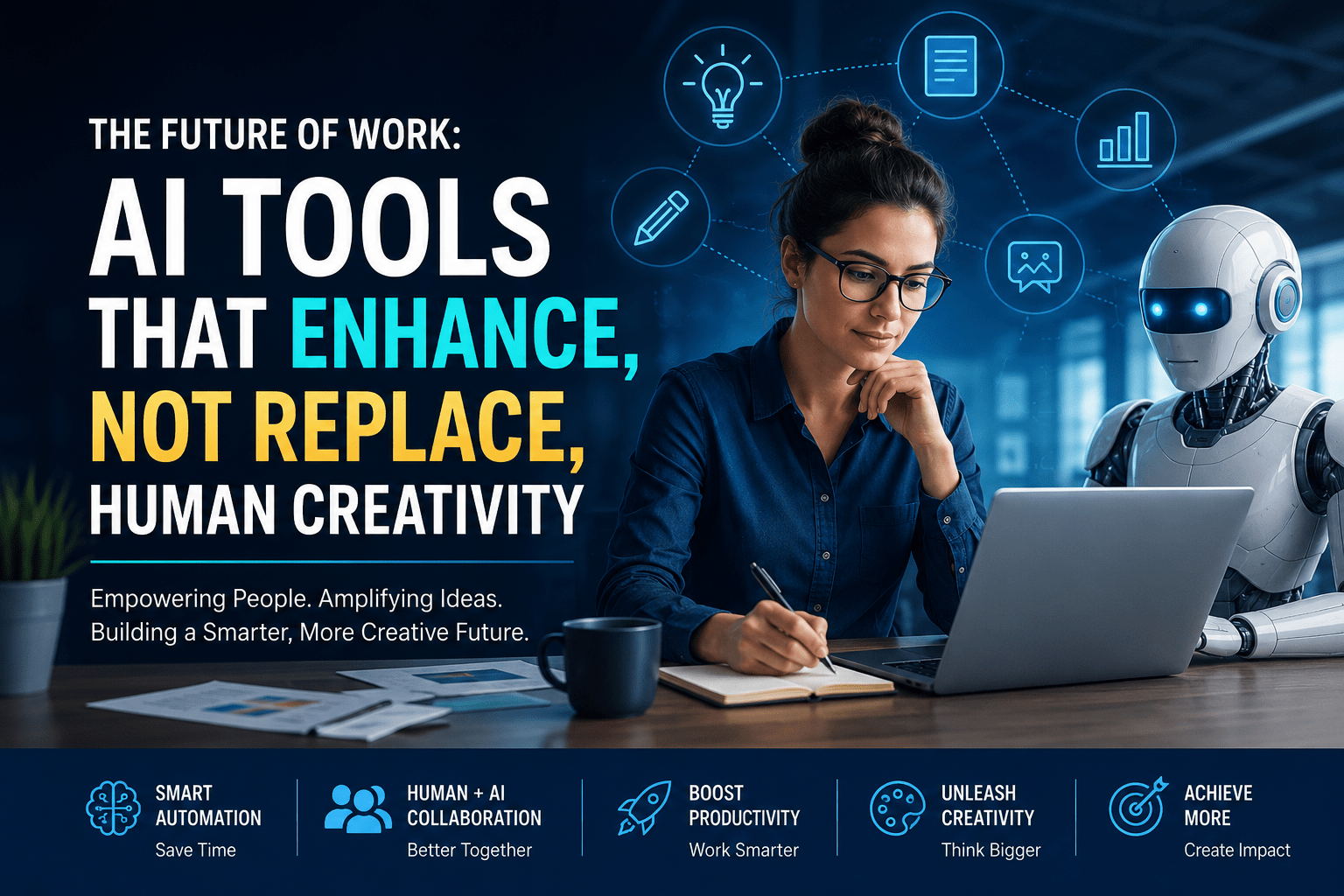
Artificial Intelligence (AI) is no longer a futuristic concept—it has become an essential part of our everyday lives and workplaces. From writing assistants and design software to coding platforms and customer service automation, AI is changing how businesses operate and how professionals accomplish their daily tasks.
While headlines often focus on robots replacing jobs, the reality is far more balanced and encouraging. The future of work is not about humans competing against AI. Instead, it is about people working alongside intelligent tools that amplify creativity, improve productivity, and unlock new opportunities for innovation.
Rather than replacing human imagination, AI is becoming a powerful partner that handles repetitive work, analyzes large amounts of data, and provides intelligent suggestions. This allows professionals to spend more time solving problems, generating ideas, and making strategic decisions—areas where human creativity continues to outperform machines.
In this comprehensive guide, we’ll explore how AI is reshaping modern workplaces, the best AI tools available today, industries benefiting the most, challenges businesses should prepare for, and practical strategies to thrive in an AI-powered future.
Understanding the New Era of Work
The workplace has undergone remarkable changes over the past decade. Remote work, cloud computing, digital collaboration, and automation have already transformed traditional office environments. AI represents the next stage of this evolution.
Unlike conventional software that follows predefined instructions, modern AI systems can:
- Analyze patterns
- Generate content
- Interpret images
- Assist with programming
- Summarize research
- Translate languages
- Brainstorm creative ideas
- Automate repetitive workflows
These capabilities don’t eliminate the need for human expertise—they expand it.
Think of AI as a highly skilled assistant rather than a replacement. It can produce a first draft, organize information, identify trends, or automate repetitive processes, but humans remain responsible for critical thinking, ethical decisions, emotional intelligence, and creative direction.
Why Human Creativity Still Matters
Despite rapid advances in AI, creativity remains one of humanity’s greatest strengths.
Creativity isn’t simply producing words or images. It involves:
- Understanding emotions
- Solving unique problems
- Building relationships
- Creating meaningful stories
- Making ethical decisions
- Thinking beyond existing patterns
- Understanding cultural context
An AI can generate marketing copy.
AI generates responses based on data it has learned from. Humans create based on experiences, emotions, curiosity, intuition, and imagination.
For example:
A human marketer understands customer psychology.
An AI can suggest website layouts.
A designer creates a memorable brand experience.
An AI can write code.
A software engineer designs scalable solutions while considering users, security, and business objectives.
This partnership creates stronger outcomes than either humans or AI working independently.
How AI Enhances Human Creativity
Instead of replacing creative professionals, AI removes barriers that previously slowed innovation.
1. Faster Brainstorming
Creative blocks affect everyone.
AI can instantly generate:
- Blog topic ideas
- Marketing campaigns
- Business names
- Video concepts
- Product descriptions
- Social media captions
Rather than copying AI outputs directly, professionals use these suggestions as starting points for original ideas.
2. Eliminating Repetitive Work
Many creative jobs involve repetitive tasks such as:
- Formatting documents
- Image resizing
- Grammar correction
- Data organization
- Scheduling
- Keyword research
AI automates these activities, giving professionals more time to focus on innovation.
3. Better Research
Research that once required several hours can now be completed much faster.
AI helps summarize:
- Reports
- Academic papers
- Market research
- Customer feedback
- Meeting notes
This allows experts to spend more time analyzing insights rather than gathering information.
4. Faster Content Creation
Content creators increasingly use AI to accelerate production.
Examples include:
- Drafting outlines
- Creating headlines
- Suggesting introductions
- Improving readability
- Fixing grammar
- Generating SEO ideas
The best creators don’t publish AI-generated content without editing. Instead, they combine AI efficiency with human expertise to produce high-quality work.
5. Personalized Learning
Professionals need continuous learning to stay competitive.
AI-powered learning platforms adapt lessons according to:
- Skill level
- Learning speed
- Career goals
- Previous performance
This personalized approach makes professional development more efficient.
Best AI Tools That Empower Human Creativity
The AI ecosystem is growing rapidly. Here are some of the most valuable categories of tools helping professionals work smarter.
AI Writing Assistants
These tools help writers, marketers, bloggers, and businesses create high-quality content faster.
Common uses include:
- Article drafting
- Email writing
- Product descriptions
- SEO optimization
- Proofreading
- Idea generation
Human editing remains essential for originality, tone, accuracy, and brand consistency.
AI Graphic Design Platforms
Modern AI design software helps users create:
- Logos
- Social media graphics
- Presentations
- Infographics
- Website visuals
Professional designers save hours while maintaining creative control over the final product.
AI Video Editing Tools
Video creators increasingly rely on AI for:
- Automatic subtitles
- Background noise removal
- Scene detection
- Voice enhancement
- Editing suggestions
This reduces production time while allowing creators to focus on storytelling.
AI Coding Assistants
Software developers use AI to:
- Generate code snippets
- Detect bugs
- Explain complex functions
- Write documentation
- Improve productivity
Developers remain responsible for architecture, testing, optimization, and security.
AI Productivity Tools
Businesses use AI for:
- Calendar management
- Meeting summaries
- Task prioritization
- Workflow automation
- Document organization
These improvements reduce administrative work and increase efficiency across teams.
Industries Experiencing the Biggest AI Transformation
AI is influencing nearly every sector of the global economy.
Healthcare
Doctors use AI to assist with:
- Medical imaging
- Disease detection
- Patient monitoring
- Administrative documentation
Healthcare professionals continue making final medical decisions while AI provides valuable analytical support.
Education
Teachers benefit from AI through:
- Personalized learning plans
- Automated grading
- Lesson preparation
- Student performance analysis
Educators gain more time for mentoring and classroom engagement.
Marketing
Marketing teams leverage AI to:
- Analyze customer behavior
- Generate campaign ideas
- Improve SEO
- Create personalized experiences
- Optimize advertising
Human creativity remains essential for building authentic brand identities and emotional connections.
Finance
Financial institutions use AI for:
- Fraud detection
- Risk assessment
- Customer support
- Investment analysis
Human experts continue overseeing compliance, ethics, and strategic decision-making.
Manufacturing
Factories utilize AI for:
- Predictive maintenance
- Quality control
- Inventory optimization
- Robotics management
- Production forecasting
Employees increasingly focus on supervision, innovation, and operational improvements instead of repetitive manual tasks.
The Rise of Human-AI Collaboration
One of the biggest misconceptions about artificial intelligence is that it is designed to replace humans entirely. In reality, the most successful organizations are using AI to complement human skills rather than eliminate them.
Think of AI as a highly capable co-worker. It can process vast amounts of information in seconds, identify patterns, and automate repetitive tasks. Humans, on the other hand, bring creativity, empathy, ethical judgment, leadership, and strategic thinking—qualities that machines cannot truly replicate.
Businesses that embrace this collaborative model are seeing improvements in productivity, innovation, and employee satisfaction.
A Practical Example
Imagine a marketing team launching a new product.
AI can:
- Analyze customer data
- Suggest trending keywords
- Generate initial ad copy
- Predict campaign performance
- Automate email sequences
The human team then:
- Refines the messaging
- Adds emotional storytelling
- Aligns the campaign with brand identity
- Makes strategic decisions
- Evaluates customer feedback
The result is a campaign that is both efficient and authentic.
Skills That Will Matter Most in the AI Era
As AI becomes more capable, employers are placing greater value on uniquely human skills. Professionals who continuously improve these abilities will remain highly competitive.
1. Critical Thinking
AI can generate answers, but it cannot always determine whether those answers are accurate, ethical, or suitable for a specific business context.
Critical thinkers evaluate information, question assumptions, and make informed decisions.
2. Creativity
Innovation remains a human strength.
Creative professionals develop:
- New business ideas
- Brand identities
- Product concepts
- Marketing campaigns
- User experiences
- Artistic works
AI can assist the process, but original vision comes from people.
3. Emotional Intelligence
Understanding emotions is essential in leadership, customer service, healthcare, education, and team collaboration.
People naturally build trust through empathy, communication, and emotional awareness—qualities that AI cannot genuinely experience.
4. Adaptability
Technology evolves rapidly. Professionals who are willing to learn new tools and adapt to changing workflows will thrive in the future workplace.
Lifelong learning is becoming one of the most valuable career investments.
5. Digital Literacy
Knowing how to use AI effectively is becoming as important as knowing how to use computers or the internet.
Digital literacy now includes:
- Writing effective AI prompts
- Evaluating AI-generated content
- Protecting sensitive information
- Understanding AI limitations
- Using automation responsibly
How Businesses Can Successfully Adopt AI
Introducing AI into the workplace requires more than purchasing software. It requires thoughtful planning and employee involvement.
Start Small
Instead of automating every department at once, begin with repetitive tasks such as:
- Data entry
- Scheduling
- Customer support FAQs
- Document summaries
- Meeting transcription
Small successes build confidence across the organization.
Train Employees
Employees should understand:
- How AI works
- Where it provides value
- When human oversight is required
- Ethical considerations
- Data privacy responsibilities
Well-trained teams are more likely to embrace AI rather than fear it.
Keep Humans in Control
AI should support decision-making—not replace accountability.
Final decisions involving:
- Hiring
- Medical care
- Legal advice
- Financial planning
- Performance evaluations
should always involve qualified professionals.
Measure Results
Businesses should regularly evaluate AI initiatives by tracking:
- Productivity improvements
- Cost savings
- Employee satisfaction
- Customer experience
- Accuracy
- Return on investment (ROI)
Continuous evaluation ensures AI delivers real business value.
Common Myths About AI and the Future of Work
Myth 1: AI Will Replace Every Job
Reality:
While some repetitive tasks will become automated, entirely new roles are emerging in AI management, prompt engineering, data governance, cybersecurity, AI ethics, and digital transformation.
History shows that technological revolutions often change jobs more than they eliminate them.
Myth 2: AI Is Always Correct
AI systems can make mistakes, generate outdated information, or reflect biases present in training data.
Human review remains essential, especially in high-stakes fields.
Myth 3: Only Large Companies Benefit From AI
Small businesses and freelancers are increasingly using AI to:
- Write content
- Create graphics
- Manage finances
- Improve customer support
- Automate workflows
Affordable AI tools are helping smaller organizations compete more effectively.
Myth 4: Creativity Cannot Be Assisted by AI
AI cannot replace imagination, but it can accelerate the creative process by generating ideas, organizing information, and reducing repetitive work.
Many writers, designers, developers, and entrepreneurs now use AI as a creative partner.
Challenges Businesses Must Prepare For
Despite its advantages, AI adoption also brings challenges.
Data Privacy
Organizations must ensure customer information is handled securely.
Sensitive business data should never be shared with AI platforms unless appropriate security measures are in place.
Ethical Decision-Making
Businesses need clear policies regarding:
- AI transparency
- Responsible automation
- Fairness
- Bias reduction
- Accountability
Trust is becoming a competitive advantage.
Workforce Reskilling
As automation increases, employees will need opportunities to learn new skills.
Forward-thinking companies invest in:
- Online training
- Certifications
- AI literacy programs
- Leadership development
Reskilling is more cost-effective than replacing experienced employees.
Managing Change
Some employees may worry that AI threatens their jobs.
Open communication, training, and involving staff in AI adoption decisions can reduce resistance and build confidence.
Emerging AI Trends Shaping the Future
The pace of innovation continues to accelerate. Several trends are expected to define the next generation of work.
AI-Powered Personal Assistants
Future AI assistants will schedule meetings, summarize projects, draft reports, organize files, and coordinate daily workflows with minimal supervision.
Hyper-Personalized Learning
Employees will receive customized training based on their strengths, career goals, and performance, making professional development faster and more effective.
Smarter Collaboration Tools
AI will improve virtual meetings by automatically creating summaries, identifying action items, translating conversations in real time, and organizing follow-up tasks.
Intelligent Business Analytics
Organizations will increasingly use AI to predict market trends, identify customer needs, and support strategic planning through advanced data analysis.
Human-Centered AI Design
Developers are placing greater emphasis on creating AI systems that are transparent, explainable, secure, and designed to support human decision-making rather than replace it.
Practical Tips for Professionals
To remain competitive in an AI-driven workplace:
- Learn at least one AI tool relevant to your profession.
- Continue developing communication and leadership skills.
- Build a portfolio showcasing creative problem-solving.
- Stay informed about industry trends.
- Verify AI-generated information before using it professionally.
- Treat AI as an assistant—not as a substitute for expertise.
- Focus on continuous learning and adaptability.
Professionals who combine technical knowledge with creativity and emotional intelligence will be well positioned for long-term success.
Conclusion
Artificial intelligence is transforming the workplace, but its true value lies in empowering people rather than replacing them. From automating repetitive tasks and streamlining workflows to supporting research and sparking new ideas, AI enables professionals to focus on what humans do best—thinking creatively, solving complex problems, and building meaningful relationships.
The future of work will be shaped by collaboration between humans and intelligent technologies. Businesses that invest in AI while also prioritizing employee training, ethical practices, and continuous learning will be better equipped to adapt to changing market demands. Likewise, individuals who embrace AI as a productivity and creativity partner will gain a significant advantage in an increasingly competitive job market.
Ultimately, success in the AI era is not about competing with machines. It is about combining the speed, efficiency, and analytical capabilities of AI with the creativity, empathy, and critical thinking that only humans can provide. By adopting this balanced approach, organizations and professionals can unlock new opportunities for innovation, growth, and long-term success.
Frequently Asked Questions (FAQs)
Q1. Will AI replace creative jobs in the future?
No. While AI can automate repetitive and time-consuming tasks, it cannot replicate human imagination, emotional intelligence, or original thinking. Creative professionals who use AI as a collaborative tool are likely to become more productive and competitive.
Q2. How does AI enhance human creativity?
AI supports creativity by generating ideas, organizing information, automating routine work, analyzing data, and providing content suggestions. This allows individuals to spend more time on innovation, storytelling, design, and strategic decision-making.
Q3. Which industries benefit the most from AI tools?
AI is making a significant impact across industries such as healthcare, education, marketing, finance, manufacturing, software development, customer service, and content creation. Nearly every industry can benefit from AI when it is implemented responsibly.
Q4. What skills are essential for the future of work?
The most valuable skills include critical thinking, creativity, emotional intelligence, communication, adaptability, digital literacy, leadership, and problem-solving. These human skills complement AI and are increasingly sought after by employers.
Q5. Can small businesses benefit from AI?
Absolutely. Many affordable AI tools help small businesses automate administrative tasks, improve customer support, create marketing content, manage projects, and analyze business data, allowing them to compete more effectively with larger organizations.
Q6. Is AI-generated content good for SEO?
AI-generated content can support SEO when it is carefully reviewed, edited, and enhanced by human experts. Search engines prioritize high-quality, original, accurate, and helpful content that demonstrates expertise and provides genuine value to readers.
Q7. How can professionals prepare for an AI-powered workplace?
Professionals should continuously learn new technologies, improve digital skills, understand how AI tools work, and strengthen uniquely human abilities such as creativity, communication, leadership, and ethical decision-making. Lifelong learning is key to staying relevant.
Q8. What is the biggest advantage of using AI at work?
The greatest advantage is increased productivity. AI handles repetitive tasks, speeds up research, improves workflow efficiency, and provides valuable insights, enabling professionals to focus on innovation, strategic planning, and delivering higher-quality results.


Leave a Reply