


When you start looking into financial planning, nothing feels more important—or more overwhelming—than choosing the right life insurance policy. You want to make sure your family is protected if the unexpected happens. However, the moment you begin researching, you are hit with a wave of industry jargon.
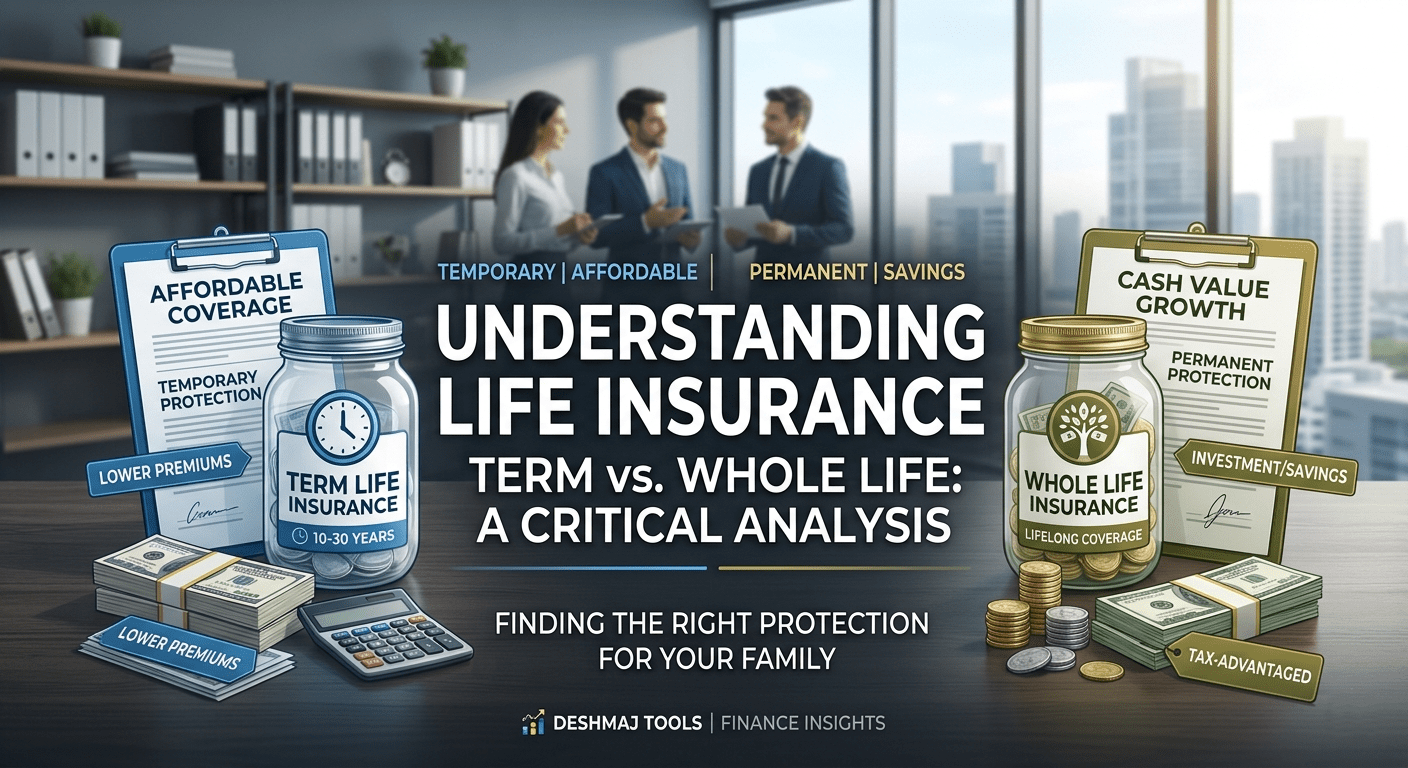
The core of the debate usually comes down to two major choices: Term Life Insurance and Whole Life Insurance.
Both options promise to protect your loved ones, but they function in completely different ways. One acts as a straightforward safety net, while the other serves as a lifelong financial asset. Choosing the wrong one can lead to wasted money or, worse, leaving your family underinsured.
This comprehensive guide breaks down the mechanics, pros, cons, and hidden costs of both types of insurance. We will help you cut through the marketing noise so you can confidently choose the best policy for your family’s future.
1. The Core Fundamentals of Life Insurance
Before diving into the comparison, it helps to understand what life insurance actually is. At its core, a life insurance policy is a contract between you and an insurance company. You pay regular premiums, and in exchange, the insurer promises to pay a specific sum of money to your beneficiaries when you pass away. This payout is known as the death benefit.
For your family, the death benefit is a financial lifeline. It can replace your income, pay off a mortgage, cover funeral costs, or fund your children’s education.
While all life insurance shares this basic goal, how and when the policy pays out depends entirely on whether you choose temporary coverage (Term) or permanent coverage (Whole).
2. What is Term Life Insurance?
Term life insurance is the most straightforward and affordable type of life insurance available. It is designed with one specific goal: to provide financial protection for a set period of time.
How It Works
When you buy a term policy, you choose the coverage amount (the death benefit) and the length of time you want the policy to last. Common terms are 10, 15, 20, or 30 years.
During this term, your premium payments remain exactly the same. If you pass away while the policy is active, your beneficiaries receive the full death benefit tax-free. If the term ends and you are still living, the policy simply expires. There is no payout, and no cash value is returned to you.
Key Features of Term Life
- Fixed Timeline: Coverage lasts only for the specific block of years you choose.
- Level Premiums: Your monthly or annual cost will never increase during the active term.
- No Cash Value: Term insurance is “pure protection.” It does not accumulate savings or investment value.
- Convertibility: Many modern term policies include a “conversion rider.” This allows you to change your term policy into a permanent one without taking another medical exam.
The Ideal Scenario
Think of term life insurance like renting an apartment or paying for car insurance. You are paying strictly for protection over a specific window of time—usually the years when your financial responsibilities are at their highest (e.g., while raising kids or paying off a 30-year mortgage).
3. What is Whole Life Insurance?
Whole life insurance is a type of permanent life insurance. It does not have an expiration date; it is designed to cover you for your entire life, as long as you continue to pay the premiums.
How It Works
Because whole life insurance is guaranteed to pay out eventually—since everyone passes away at some point—it is significantly more complex and expensive than term insurance.
Every time you make a premium payment on a whole life policy, the insurance company splits the money into two parts:
- The Cost of Insurance: This goes toward maintaining the death benefit and covering administrative fees.
- The Cash Value Component: This acts as a forced savings account that grows over time at a guaranteed rate set by the insurance company.
Key Features of Whole Life
- Lifelong Coverage: The policy remains active until your death, regardless of how old you get or how your health changes.
- Guaranteed Cash Value Growth: The savings portion grows tax-deferred. You can borrow against this cash value or withdraw it during your lifetime.
- Fixed Premiums: Just like term insurance, the premiums are locked in for life. However, they start out much higher.
- Potential for Dividends: If you buy a policy from a “mutual” insurance company, you may receive annual dividend payments based on the company’s financial performance. You can take these as cash, use them to lower your premiums, or reinvest them into the policy.
The Ideal Scenario
Whole life insurance is like buying a house. It requires a much larger financial commitment upfront, but it builds equity (cash value) over time that belongs to you.
4. Head-to-Head Comparison: Term vs. Whole Life
To see how these two options stack up against each other, let’s look at a direct breakdown of their core traits.
| Feature | Term Life Insurance | Whole Life Insurance |
|---|---|---|
| Coverage Duration | Temporary (10 to 30 years) | Permanent (Your entire life) |
| Premium Cost | Low and affordable | High (often 5x to 10x more expensive) |
| Cash Value | None | Yes, accumulates over time |
| Payout Certainty | Only pays if you die during the term | Guaranteed to pay out eventually |
| Complexity | Simple and easy to understand | Complex with investments and loans |
| Main Purpose | Income replacement during peak debt years | Wealth preservation and lifelong protection |
5. The Financial Breakdown: Cost vs. Value
The biggest factor that drives people toward term life insurance is the price tag. Because term insurance only covers a specific window of time and does not build cash value, the insurance company takes on less risk. They pass those savings on to you.
Why Whole Life Costs More
With whole life insurance, the company knows they will eventually have to pay out the death benefit. Furthermore, managing the cash value investment portfolio requires administrative work. To cover these costs and fund the cash value account, whole life premiums are vastly higher than term premiums for the exact same amount of coverage.
The “Buy Term and Invest the Difference” Strategy
A common piece of advice among financial planners is to “buy term and invest the difference.”
Instead of spending $250 a month on a whole life policy, you could spend $30 a month on a term life policy with the exact same death benefit. You then take the remaining $220 and invest it into an index fund or a retirement account like an IRA.
Over 20 or 30 years, historical stock market returns will often net you a much larger pool of wealth than the guaranteed cash value growth inside a whole life policy. However, this strategy requires strict personal discipline to actually invest the money rather than spending it.
6. Understanding the “Cash Value” Component
The cash value inside a whole life policy is often marketed as a major benefit, but it is important to understand exactly how it works before buying in.
Accessing Your Cash Value
As your cash value grows, you can access the money in a few ways:
- Policy Loans: You can borrow money from your policy’s cash value. There are no credit checks, and you don’t technically have to pay it back. However, any unpaid loan balance plus interest will be deducted from your family’s death benefit when you pass away.
- Withdrawals: You can withdraw cash directly. Up to the amount you’ve paid in premiums, this money is completely tax-free.
- Surrendering the Policy: If you decide you no longer need the insurance, you can cancel the policy and walk away with the accumulated cash value (minus any cancellation fees).
The Hidden Catch
A common misconception is that when you pass away, your family receives both the death benefit and the accumulated cash value. This is not true.
With a standard whole life policy, the insurance company keeps the cash value when you die. Your beneficiaries only receive the face value death benefit. The cash value is purely a living benefit for you, not an extra bonus for your heirs.
7. Pros and Cons of Term Life Insurance
The Pros
- Unbeatable Affordability: You get the maximum amount of financial protection for the lowest possible cost.
- Simplicity: There are no complex investment rules, hidden fees, or loan terms to track.
- Targeted Protection: You can match the length of the policy to your specific financial milestones, like the duration of your mortgage or the years until your kids graduate college.
The Cons
- No Return on Investment: If you outlive the policy, you do not get your premium payments back.
- Temporary Safety Net: If you still need life insurance when the term expires, buying a new policy will be much more expensive because you will be older and potentially less healthy.
8. Pros and Cons of Whole Life Insurance
The Pros
- Guaranteed Payout: Your family is guaranteed a financial cushion no matter when you pass away, as long as premiums are paid.
- Forced Savings Account: For individuals who struggle to save money consistently, the cash value component forces a disciplined saving habit.
- Tax Advantages: The cash value grows tax-deferred, and the death benefit is passed to beneficiaries completely free of income tax.
The Cons
- High Monthly Expense: The steep premium costs make it easy to drop the policy if you fall into financial trouble.
- Slow Early Growth: During the first few years of the policy, almost all of your premium goes toward commissions and administrative costs, meaning your cash value grows very slowly at the start.
- Complex Financial Rules: Borrowing against the policy involves interest rates, and navigating the tax implications can require professional advice.
9. Key Questions to Help You Choose
If you are still on the fence about which policy fits your family best, ask yourself these four questions:
1. How much coverage does my family actually need?
Calculate your total financial obligations: your mortgage balance, outstanding debts, future college costs, and annual income replacement needs. If you need a large policy (like $500,000 or $1 million) to keep your family safe, a term policy is usually the only affordable option for average households.
2. What is my current monthly budget?
Never buy a policy that stretches your finances to the limit. If you buy a whole life policy and have to cancel it a few years later because the premiums are too high, you lose your coverage and miss out on the cash value growth. Pick a premium you are certain you can afford for the long haul.
3. How long will my dependents rely on my income?
If you just want to make sure your kids are taken care of until they are adults and your mortgage is paid off, a 20-year or 30-year term policy covers that window perfectly.
4. Do I have a unique, lifelong financial obligation?
Do you have a child with special needs who will require lifelong care? Do you have a massive estate that will face heavy taxes when you pass away? If your financial obligations will never go away, a permanent whole life policy is designed for these exact situations.
Conclusion
At the end of the day, there is no single “best” life insurance policy—there is only the policy that is right for your unique financial situation.
For the vast majority of families, Term Life Insurance provides the most practical value. It gives you maximum protection during the years you need it most, without draining your monthly budget. This frees up your cash to pay off debt, build an emergency fund, and invest for retirement in traditional accounts.
However, if you have a high net worth, require permanent estate planning, or need to fund a lifelong care trust for a dependent, Whole Life Insurance offers specific wealth preservation tools that term insurance cannot match.
The most important step is simply taking action. Review your debts, talk openly with your partner about your family’s future needs, and lock in a policy while you are young and healthy to secure the best possible rates.


Leave a Reply